The Drugs Change. The Human Need Doesn’t.
He is 22, works in a warehouse in the north of England, and wanted what most people want from a Friday night with friends: to join in. Without alcohol, though, he could spend much of the night silent, afraid of saying the wrong thing and unable to find a way into conversations everyone else seemed to be enjoying.
Matt — not his real name — described the routine to BBC journalists this summer. Two years ago, he changed the method. He now takes pregabalin, a prescription medicine usually used for epilepsy and nerve pain, alongside propranolol, a beta blocker. He discovered the drugs through social media and buys the pregabalin illegally online. He says they ease his anxious thoughts and make socialising easier without the hangover he got from drinking. They also leave him feeling euphoric.
There are obvious risks. High-dose or inappropriate use can be dangerous, pregabalin can lead to dependence, and buying medicines from an unregulated source adds another problem: you cannot be certain that what arrives is what you thought you bought.
But before deciding what Matt’s behaviour says about him, there is another question worth asking.
What was he trying to make available?
Conversation, perhaps. Ease. Belonging. A way into the night.
There is also something the BBC story cannot tell us. What happens if the room changes?
Put Matt with one or two close friends over coffee, walking somewhere, or sitting around a kitchen table with people he has known for years. Does he still struggle in the same way? We don’t know. Perhaps he does. Perhaps he talks for hours.
That difference would matter, because I struggle in some social situations is a very different judgement from I need something in order to socialise.
A bigger night out changes more than the number of people present. Conversation moves faster. There is noise and interruption, more attention to manage and, very often, alcohol already woven into the evening. Someone buys a round. Someone puts a drink in your hand. Everyone else seems to be joining in.
Drinkaware found that 69% of 18–34-year-old drinkers had felt pressure from friends to drink more, while 47% had drunk more than they expected because they wanted to keep up with others. Nobody needs to announce that peer pressure has begun. It can arrive as a round, a joke, a raised eyebrow, or simply the small awkwardness of being the only person holding a glass of water.
We cannot say that happened to Matt. What we can say is that the room matters.
Sometimes we change our internal state to fit the external state of the room.
A drink may reduce anxiety, but it may also help someone keep pace with the group, stay longer, loosen up, or avoid feeling like the person standing outside a shared ritual. Seen that way, the behaviour becomes more interesting and understandable if we break it down.
UK clinical guidance on social anxiety that alcohol or drug misuse is often an attempt to reduce anxiety in social situations. Sometimes you learn more by asking not only what somebody is doing, but what the behaviour is doing for them.
Humans have been asking substances to do jobs for us for a very long time.
Human beings have always found ways to alter the conditions inside themselves — from Roman wine and Victorian laudanum to the psychedelics of the 1960s and ecstasy-fuelled nights of the 1990s. The substances change. The human impulse does not.
We have changed our state to celebrate, endure, fight, perform, worship, connect, create, sleep, have sex, dance, escape and sometimes simply get through the day.
What we want from that altered state has changed with the world around us too. Roman wine was woven into social gatherings involving food, entertainment and status. Victorian laudanum belonged partly to a world in which powerful medicines were readily bought over the counter for pain and everyday ailments. Psychedelics became entangled with the 1960s search for altered consciousness, spirituality and different ways of living. By the late 1980s and 1990s, MDMA fitted remarkably well with rave culture: all-night dancing, music, physical closeness and a new kind of temporary community. Ecstasy became known as “the hug drug” because of its association with empathy and connection.
No decade has one motive and no drug has one meaning. Plenty of Romans drank because they liked wine. Plenty of people took ecstasy because they wanted to get high. Still, the conditions of an age can shape not only what people take, but what they hope a changed state will give them.
And sometimes the order runs the other way.
MDMA was not invented for rave culture. Merck first synthesised it in 1912, decades before warehouse parties and dance music could give it that particular meaning. Researchers who later went back through Merck’s archives found that it was simply an unimportant chemical precursor in work on another substance. It was not even tested pharmacologically at the time.
A later social world discovered that its effects happened to fit something the moment was already looking for. The moment, in other words, found the drug.
Once demand becomes visible, however, markets can respond. If people want stimulation, sedation, escape, intimacy, confidence or some other altered state, chemistry and manufacture do not have to sit still. New compounds can be created, existing ones modified, potency changed and legal controls worked around.
Sometimes the moment finds the drug. Increasingly, the market can make drugs for the moment.
Then add modern distribution.
Think about the Silk Roads. They connected distant markets and transformed what people could buy, but the goods themselves still had to cross the geography between seller and buyer. Every border, port, stretch of road, trader and day of travel added friction.
Today the information can move almost instantly. A substance might be manufactured in one country, marketed from another and ordered by somebody somewhere else entirely. Social media can introduce the idea, messaging can connect buyer and seller, and postal networks can finish the journey.
For a young person in a provincial town, that is a profound change in availability. They may no longer need the local contact, the friend of a friend or the trip to a bigger city that previous generations relied on. The National Crime Agency says online marketplaces are expanding the reach of illicit sellers, with illegal drugs and prescription medicines now sold through both clear-web and dark-web markets; it has also documented increasing use of postal systems to distribute drugs around the UK.
The internet hasn’t abolished geography, but it has made it much less decisive.
The scale is already significant. UK regulators seized nearly 20 million doses of illegally traded medicines during 2025 and disrupted more than 1,500 websites and social-media accounts selling medical products illegally.
Manufacture is changing just as quickly. At the end of 2025, Europe’s drug monitoring agency was tracking 1,050 new psychoactive substances. Fifty had appeared in Europe for the first time that year alone, including 27 new cannabinoids. The agency describes new substances continuing to emerge specifically to get around legal controls.
The human desire to change how we feel may be timeless. The number of ways available to do it is not.
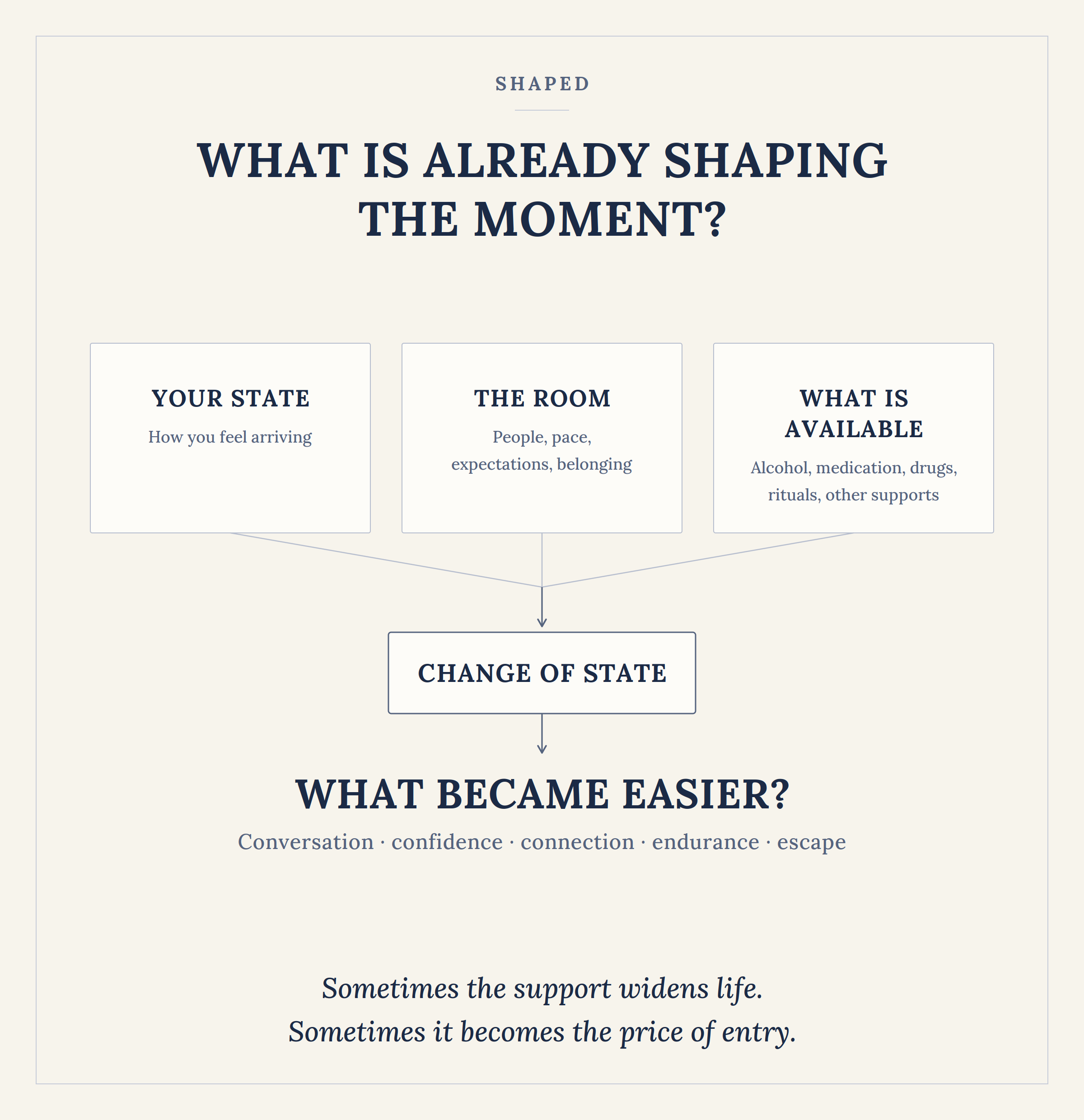
We tend to begin the story at the moment somebody swallows the pill, takes the drink or uses the drug. By then, quite a lot has already happened. The person has arrived with their own state and history. The room has created pressures and possibilities. Someone has manufactured something capable of changing that state. A platform may have made the idea visible and a distribution system has put it within reach.
None of that removes choice or responsibility. But Matt’s decision did not begin at the moment he swallowed a pill. His anxiety, the social situations he was trying to navigate, what he had found online and what he could actually get hold of were already part of it.
Then comes the part that may stay with somebody much longer than the substance itself: what they conclude from what happens next.
For Matt, something that began with nights out has spread into dates and family gatherings. He now says there are social situations he would not even attempt without the drugs. BBC reportBBC that is where something that widens life can begin, slowly, to narrow it.
If something works, we tend to repeat it. Repetition produces experience, and that experience becomes evidence. Eventually it may support a judgement: this is the only way I can do this.
Perhaps that judgement is right. Perhaps it is partly right. Perhaps the support really is necessary. Or perhaps the person has never had enough experience under different conditions to know.
The altered behaviour is real. What it tells you about your enduring capability is still an open question.
And this is much bigger than pregabalin, alcohol or whatever new substance appears next. Most of us use something to make a particular state easier to reach: caffeine, music, exercise, a ritual, certain clothes, even a particular person beside us. Usually we barely think about it.
Sometimes those things widen life enormously. Sometimes, without us quite noticing, they become the price of entry.
So perhaps the useful question is not simply what somebody is taking. It is what they were trying to make available.
The human need has been with us for a very long time. What is changing, fast, is how many ways we can now find to answer it — and how little distance may remain between wanting to feel different and finding something that promises to make it happen.