Why the behaviour you repeat is shaped by what repeatedly surrounds it
The plan looked simple on Sunday night: leave the phone outside the bedroom, get up when the alarm sounds and write for twenty minutes before the day begins.
On Monday, it works. The phone stays on the landing. The page fills. You feel like someone who has finally become disciplined. By Thursday, you are awake later, the phone is back beside the bed and the writing has disappeared. The promise is the same. The person is the same. The pattern is not.
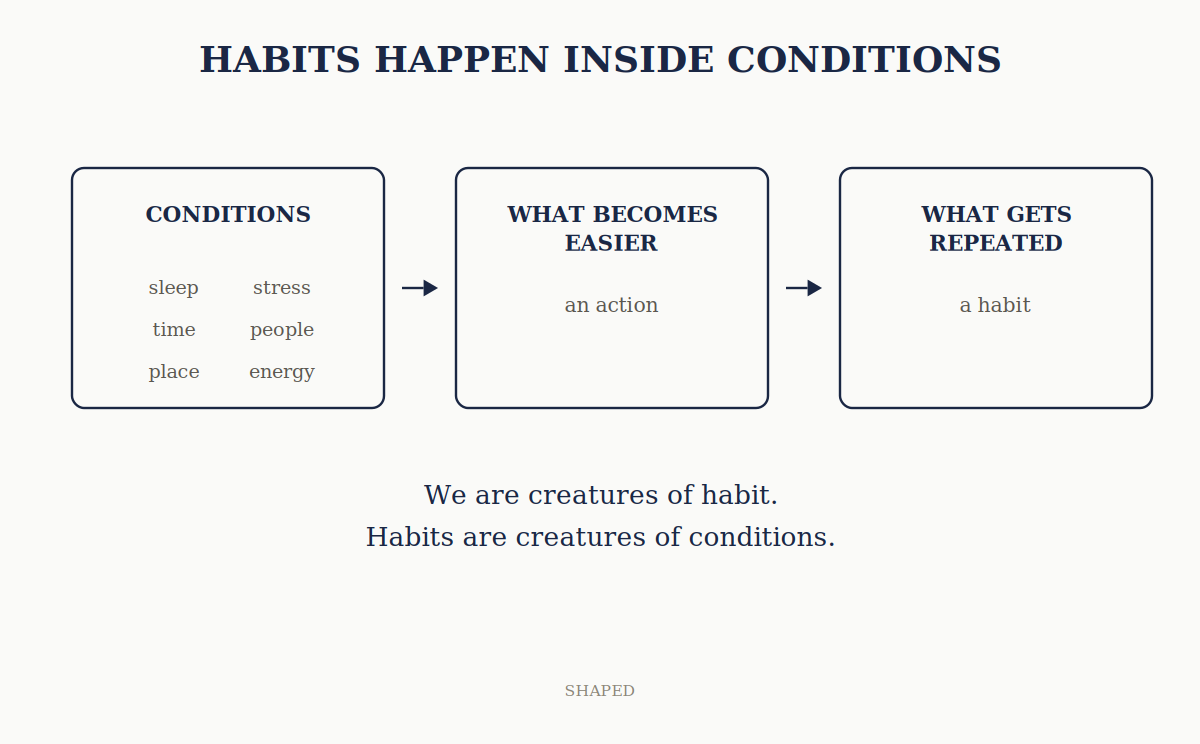
We are creatures of habit. But habits are creatures of conditions.
We often explain the difference as willpower: Monday proved that you could do it; Thursday proved that you did not want it enough. That explanation contains some truth. Repetition and deliberate practice matter, and people can learn to act even when an action is uncomfortable. But a habit never enters empty space.
Even familiar habit advice becomes most useful when it starts shaping conditions: remove the cue, prepare the first step, attach a new action to an existing routine, add accountability or reduce friction. These methods are often presented as ways to become more disciplined. In practice, they also change what reaches you before discipline is required.
The habit is not travelling alone
Every repeated action arrives inside an arrangement: a time, a place, a cue, a level of effort, the state of the body, the people nearby, the expectation attached to the task and the reward or relief that follows.
The morning writing habit may be supported by an early bedtime, a quiet room, a prepared desk and a first sentence left unfinished the night before. Evening scrolling can be supported just as effectively by fatigue, a phone within reach, no clear stopping point and the immediate relief of not having to think about anything demanding.
Neither description removes choice; it makes the choice more accurately visible. The behaviour is still yours, but the conditions help decide how much effort is required to reach one action rather than another. Over time:
What repeatedly becomes easiest to reach is more likely to become what you repeatedly do.
Conditions can rehearse a behaviour before you choose it
A cue does not have to issue an instruction. It only has to make one response more available. The kettle goes on and the biscuit tin is beside it. A difficult email arrives and your hand moves towards the phone. You pass the gym on the way home and training requires no second journey. A friend expects you at the corner, so the walk begins before motivation has been debated.
Over time, the arrangement starts to carry part of the action. This is why the same person can appear highly disciplined in one part of life and unreliable in another. One behaviour may have a stable time, a clear cue, social support and an immediate reward. The other may have to be rebuilt from intention every day.
The contrast is not proof that character is irrelevant. It is evidence that character is not acting alone. When we remove the surrounding conditions from the story, we turn the repeated result into a verdict: I am consistent. I am lazy. I have no self-control. I always give up.
The behaviour was real. The conclusion may not be.
Habits become conditions too
Once established, a habit does more than record what you have done; it changes what becomes easier next. Preparing lunch the night before reduces the decisions required the following day. A regular walk creates a familiar route and a known beginning. Writing at the same time teaches the day where writing belongs.
A habit can therefore become part of the conditions supporting another habit. The reverse can happen too. Staying on the phone late changes sleep; reduced sleep can alter appetite, patience and attention, making another set of actions easier to reach the next day.
This is not a neat machine in which one condition guarantees one behaviour. People resist cues, break patterns and act against the grain. Illness, care, work, disability, money and other people can also place real limits on what can be changed. Even so, repeated behaviour and repeated conditions can begin shaping each other.
Change the habitat, not only the promise
Choose one habit you are trying to build, reduce or simply understand, and look at the ten minutes before it happens. What usually comes first? What makes the current response easy to reach, and how much effort does the preferred action ask for? What immediate reward or relief follows each option?
Then change one condition. Put the phone beyond reach rather than beside your intention. Prepare the first step before energy falls. Move the task to a time when fewer demands compete with it, or add a person, a boundary, a visible cue or a clear stopping point. Keep the experiment small enough that you can tell what it affected.
If the new condition changes nothing, that is useful evidence too. The barrier may be skill, exhaustion, fear, pain, overload or something the experiment did not touch. If things become a little easier, resist turning that into proof of a new identity; mark what changed and repeat the test.
Sometimes the honest action is not to optimise the habit at all. It may be to rest, repair harm, seek support, change a demand or accept that a valued action is not available in its old form today.
Read the conditions before you judge the creature
Habits matter because repeated actions accumulate. They shape skill, health, relationships and eventually some of the evidence from which we judge ourselves. But those habits have also been learning from a particular life.
Before you decide that a pattern reveals who you are, ask what has repeatedly been making that pattern available.