What Crump’s Law means for how we build AI
We are teaching AI to find more of our past. The harder design problem is what it should do when the old evidence is still true – but the person and the judgement have moved on.
Seven years ago, an employee’s appraisal recorded a problem. Technically strong, their manager wrote, but they avoided difficult conversations and struggled when conflict became personal.
Since then, they have led a difficult service change, mentored colleagues and received strong feedback for handling disagreement. Now they are being considered for promotion.
An AI assistant searches the organisation’s records and puts the old appraisal back on the screen alongside the later evidence. What should it surface first? What should it summarise? What belongs in the answer to the promotion panel, and what belongs only in the history?
Imagine being that employee. You have spent seven years doing the work the old appraisal said you could not yet do. You have had the awkward conversations, made mistakes, learned how to stay in the room and built a different record. Then a machine can retrieve one sentence from the earlier version of you in less time than it takes you to introduce yourself. The sentence is not unfair because it is false. It is dangerous if its ease of retrieval gives it more authority than it has earned.
Someone chose to make that retrieval possible. The assistant was configured to search years of appraisal notes, training records, project feedback and performance reviews. The promise is obvious: less hunting through folders, fewer missed facts, a fuller picture of the person in front of you.
The case is hypothetical. The capability is not. The UK Information Commissioner’s Office has audited AI tools used in applicant sourcing, screening and selection. Those audits excluded generative AI, but they found systems drawing on large amounts of candidate information, and raised concerns about tools collecting more data than necessary and retaining it indefinitely. As AI moves further into organisational records, the question will not only be what it can retrieve. It will be what that retrieval makes more important.
The harder case is the memory that is still true
AI researchers are already working on a difficult memory problem: what should an agent do when something it remembers has become stale? A preference changes. A state is superseded. A later fact replaces an earlier one. Recent work on long-term agent memory is explicitly trying to detect and update those cases.
That matters. Crump’s Law points to a harder case: the old memory has not become false or been superseded. It remains true even though what it represents for the judgement being made now may have changed.
The harder case is when the old evidence remains true.
An employee may really have struggled with conflict. A clinician may really have made a serious error. A person may really have defaulted on a loan, failed an exam, behaved badly, held a view they later rejected, or once been very good at something they no longer practise. Later evidence does not erase the earlier fact. It changes the question we have to ask of it.
Crump’s Law describes the collision: As people change through time, technology can make evidence of earlier versions of them increasingly available to the judgement being made now.
The distinction is easy to miss because we are used to treating accuracy as the goal. The ICO’s accuracy guidance makes a useful point: a historical record can remain accurate even when circumstances have changed, provided it is clear that the information is historical. If somebody once lived in one city and later moved to another, the earlier address does not become false simply because life moved on.
People are harder than addresses. A true old fact can remain part of the record while becoming a weaker description of the person for one judgement, a strong description for another, and a vital clue when combined with a pattern we could not see before.
What judgement are we actually making?
In the earlier Crump’s Law article, I separated four different jobs a judgement can be doing. Go back to the old appraisal. As a historical record of what happened seven years ago, the note is direct evidence. In a judgement about responsibility at the time, it may still deserve serious weight. In a judgement about current capability, the later evidence matters much more. In a prediction about performance in a bigger role, both the earlier weakness and the later development may matter, alongside the conditions of the new job.
The evidence did not change. The judgement did.
That sounds obvious when a human reads the examples slowly. It becomes less obvious when a system searches thousands of records in seconds and returns the most relevant-looking fragments. Relevance to the search is not the same as weight in the judgement. What gets compressed into the summary can become the story the panel believes it has read.
Writing about AI and informed consent, I. Glenn Cohen and Andrew Slottje make a related point: a system that locates and foregrounds some records rather than others is already doing more than simply reporting. Selection can assign importance. That does not prove the design rule I am arguing for here. It does show why ‘a human still makes the final decision’ is not enough to make retrieval neutral.
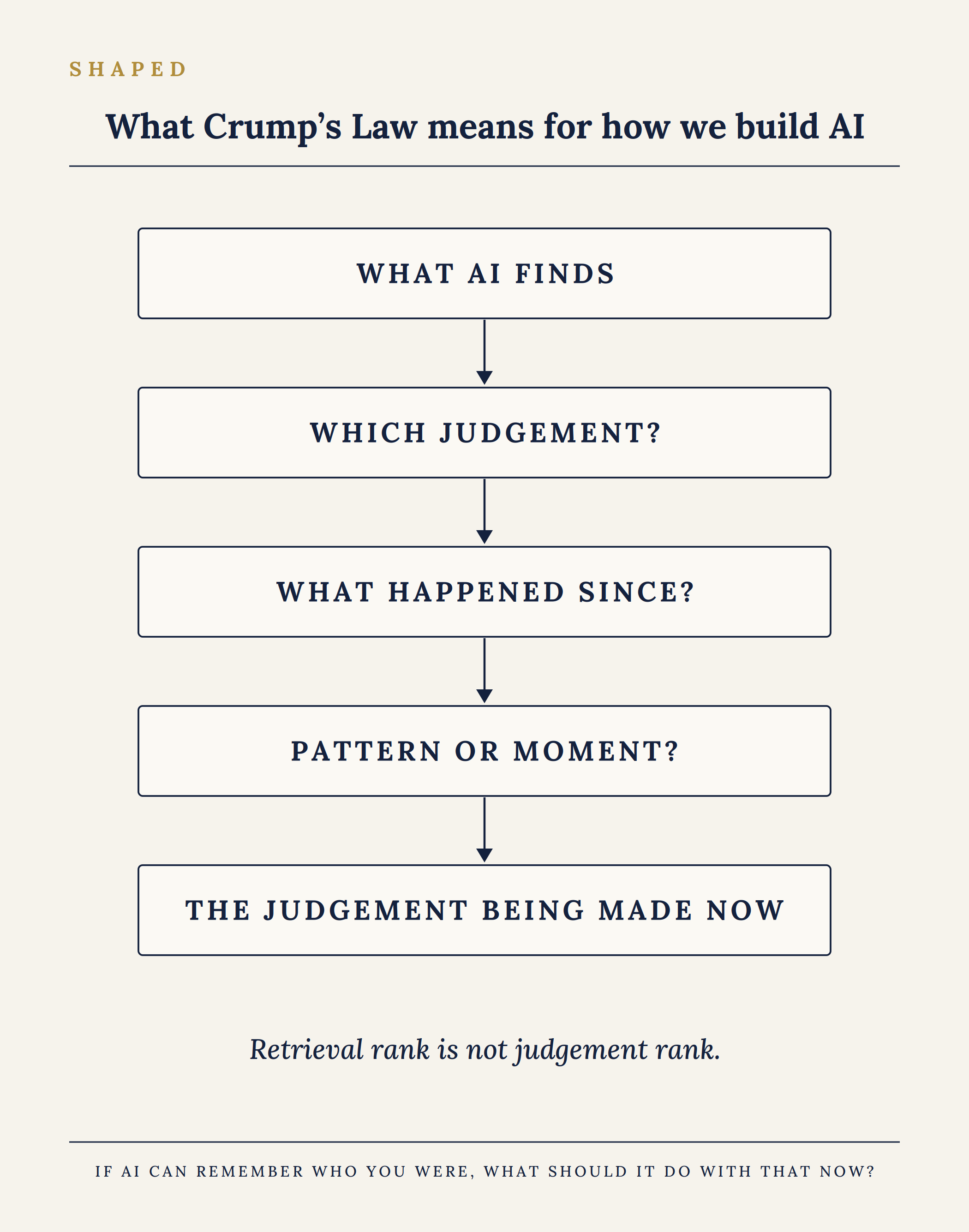
WHAT AI FINDS → WHICH JUDGEMENT? → WHAT HAPPENED SINCE? → PATTERN OR MOMENT? → THE JUDGEMENT BEING MADE NOW
Retrieval rank is not judgement rank.
Look for what happened since
Once the judgement is clear, one design consequence follows. If an AI system surfaces an old fact that could influence the decision, it should not search only for more evidence that confirms the same history. Within the sources the organisation is already entitled to use, it should also look for evidence of what happened since: development, contradiction, recurrence, recovery, deterioration or continuity.
That is not a demand to collect more data about everyone. It is not a rule that newer evidence wins. It is a requirement to avoid making one period of a life disproportionately available simply because it was well recorded, easy to index or highly similar to the words in the query.
Think again about the promotion case. An assistant that retrieves the seven-year-old concern but fails to retrieve later evidence about the same capability has not fabricated anything. It can be factually accurate and still leave the decision-maker with a badly shaped case.
The opposite can happen too. A system that automatically favours the latest evidence could be equally dangerous.
Now reverse the case
Imagine the judgement is no longer a promotion. It concerns professional risk, safeguarding or repeated fraud. A serious incident from years ago appears in the record. There is newer evidence suggesting better behaviour. Should the system push the old event down because it is old?
There is another person in this version of the story too: the person who may be harmed if the pattern is missed. They do not benefit from a system that mistakes ‘old’ for ‘finished’. A design built only to protect people from their past can become careless about the people whom that past may still help protect.
Professional regulation already lives with this tension. Nursing and Midwifery Council guidance asks panels to consider current fitness to practise, including insight and strengthened practice since earlier events. That creates room for real development to matter. The same guidance also treats seriousness, repetition and patterns of behaviour as important. An older event can therefore become more significant, not less, when another event shows that it was not isolated.
The regulator is not giving AI designers a specification. It is showing the same problem inside a mature human decision process: later evidence can change what an old event means, while an old event can gain weight when it reveals a pattern.
This is why a simple recency rule fails. ‘Use the latest evidence’ sounds humane until the older evidence is the part that protects somebody else. ‘Keep the whole history prominent’ sounds cautious until an earlier version of a person becomes permanently easier to see than the person they have become.
The design has to leave the judgement open to both possibilities.
The safeguard has an appetite
There is a harder consequence. If we want AI to judge whether an old fact still represents someone, the system may need more of that person’s life, not less. It needs later evidence. Context. Contradiction. Evidence of what happened under different conditions. A safeguard against being frozen in the past can become an argument for making more of the life queryable.
That should make us uncomfortable.
The same problem is unevenly distributed. Some people work in environments where everything is recorded: regular appraisals, measurable outputs, project logs, learning records, written feedback. Their development can leave a rich trail. Others have thinner records. They change role. Work somewhere with poor documentation. Take time out to care for somebody. Develop in ways no system happens to measure.
Two people could have changed by the same amount and leave radically different evidence behind. One has six formal reviews, three leadership programmes and years of written feedback. The other changed job twice, spent a year caring for a parent and worked in teams where good work was noticed but rarely recorded. A retrieval system will find the first person’s development more easily. That does not mean the first person developed more.
If an AI system treats the absence of later evidence as evidence that nothing changed, it will mistake documentation for development. The person with the richest record gets the easiest route to proving they moved on.
The answer cannot simply be ‘let them correct the record’. Being able to challenge the record matters, but it can create another burden: a person may be forced to explain the same old fact again and again because the system keeps finding it again and again. A right to reply is not the same as a duty to keep prosecuting your own past.
So what should we build differently?
AI should not silently convert retrievability into authority.
That sentence is not Crump’s Law. The law describes the problem. This is SHAPED’s judgement about how we should respond to it.
I think four things follow. They are design proposals, not claims that current regulation or AI research has already settled the problem.
First, systems should preserve the difference between historical truth and current description. The record should be allowed to remain true without being silently rewritten as a label for the person now.
Second, the judgement should be explicit before the system ranks or summarises evidence. A search for historical accountability is not the same task as a judgement about current capability, and neither is the same as predicting what happens next.
Third, when old evidence could shape the decision, systems should look for material evidence of what happened since with comparable seriousness. That means change, contradiction and continuity should all have a fair chance to reach the judgement. Comparable seriousness is a design intent, not a metric. It does not mean collecting everything or automatically preferring the latest record.
Fourth, systems should distinguish an isolated moment from a pattern. Age alone cannot tell us which one we are looking at.
Other safeguards already familiar in responsible AI still matter: where the evidence came from, why something was surfaced, a route to challenge the record, and the ability for a system to say that it cannot establish what the old evidence represents now. Those are supports. They do not answer the central question for us.
Responsibility sits at more than one layer. Foundation-model developers can make reasoning across time, source tracking and uncertainty easier. The application or retrieval supplier controls which records are searched, how they are ranked and what gets compressed into a summary. Commissioners and procurers decide which judgements the system is being bought to influence and what safeguards the contract requires. Deploying organisations decide which data stores are actually connected. The professional or institution still owns materiality, weight and the final judgement. The model company cannot know every judgement being made downstream.
That makes procurement and configuration less mundane than they look. A field in a specification that says which records may be searched, how long they are retained, or whether the system must look for later contradictory evidence can determine whose past becomes easy to see. By the time the user sees a neat summary on screen, some of the most consequential judgement choices may already have been made upstream.
Remembering is not judging
There is one final reason this matters. A judgement does not simply describe a person. It can change what happens to them next.
If the old appraisal helps block the promotion, the employee may never get the bigger role in which they could produce stronger evidence of leadership. Years later, another system may search the record and find plenty of evidence that they were never promoted — and very little evidence of what they might have done if they had been.
The absence created by that decision can then look like evidence: a future system may faithfully report that the person never demonstrated the capability, without seeing that an earlier judgement helped decide whether the opportunity to demonstrate it ever existed.
That does not mean the original judgement was wrong. It means judgements create conditions as well as conclusions. A judgement can alter the conditions from which later evidence is produced.
As AI becomes better at searching, joining and compressing the records of a life, this responsibility moves earlier in the chain. The system participates before it recommends a verdict. It participates when it decides what becomes visible, what sits together and what is easy for the human to notice.
We should want AI to remember accurately. We should want important history to survive. Sometimes the old record is the thing that protects us, vindicates us or reveals the pattern everyone missed.
AI may remember more of us than any human decision-maker could. The question is whether it helps us judge that memory — or lets the memory do the judging.
Sources
Information Commissioner’s Office (ICO), Principle (d): Accuracy, UK GDPR guidance. Accessed 13 September 2026. The page states that the guidance is under review following the Data (Use and Access) Act. https://ico.org.uk/for-organisations/uk-gdpr-guidance-and-resources/data-protection-principles/a-guide-to-the-data-protection-principles/accuracy/
• Information Commissioner’s Office, AI in Recruitment Outcomes Report, 6 November 2024. The audits covered providers and developers of applicant sourcing, screening and selection tools; generative AI was outside scope. https://ico.org.uk/media2/migrated/4031620/ai-in-recruitment-outcomes-report.pdf
• Information Commissioner’s Office, “Thinking of using AI to assist recruitment? Our key data protection considerations,” 6 November 2024. https://ico.org.uk/about-the-ico/media-centre/news-and-blogs/2024/11/thinking-of-using-ai-to-assist-recruitment-our-key-data-protection-considerations/
• Haoran Sun, Zekun Zhang and Shaoning Zeng, “Preference-Aware Memory Update for Long-Term LLM Agents,” Findings of ACL 2026, pp. 783–793. DOI: 10.18653/v1/2026.findings-acl.38 https://aclanthology.org/2026.findings-acl.38/
• Hanxiang Chao, Yihan Bai, Rui Sheng, Tianle Li and Yushi Sun, “STALE: Can LLM Agents Know When Their Memories Are No Longer Valid?”, arXiv:2605.06527, 2026. https://arxiv.org/abs/2605.06527
• I. Glenn Cohen and Andrew Slottje, “Artificial intelligence and the law of informed consent,” in Barry Solaiman and I. Glenn Cohen (eds), Research Handbook on Health, AI and the Law, Edward Elgar, 2024, Chapter 10. DOI: 10.4337/9781802205657.ch10https://www.ncbi.nlm.nih.gov/books/NBK613199/
• Nursing and Midwifery Council, Insight and strengthened practice. https://www.nmc.org.uk/ftp-library/understanding-fitness-to-practise/insight-and-strengthened-practice/
• Nursing and Midwifery Council, The concept of seriousness in fitness to practise cases. https://www.nmc.org.uk/globalassets/sitedocuments/news/february-2022_concept-of-seriousness-in-fitness-to-practise-cases.pdf