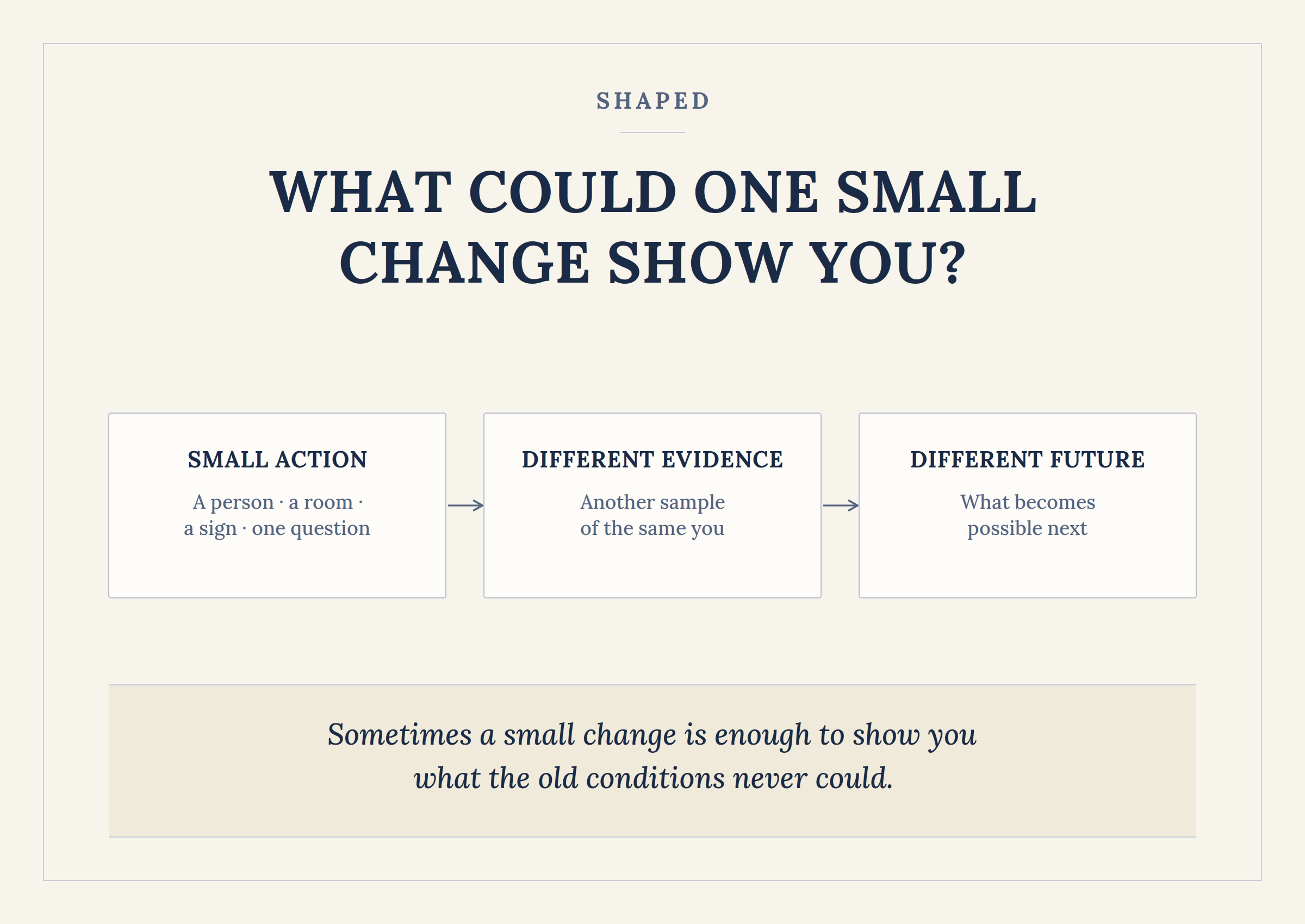
Sometimes a different person, room, constraint or small action produces different evidence — and a different future.
In the late 1990s, Katalin Karikó kept meeting another scientist at a photocopier at the University of Pennsylvania. She had spent years working on messenger RNA and had already received a fairly brutal institutional verdict: her work was going nowhere. She had been demoted. Grants were hard to win. Recognition was scarce.
Drew Weissman had a different problem. He was an immunologist. Karikó knew how to make RNA; Weissman knew what the immune system did to it. By several accounts, their early conversations began because they kept wanting the same photocopier.
Nothing about that queue looked consequential. It was two researchers waiting to copy papers.
Yet the encounter changed what experiment they could run next.
Their first attempts did not produce a triumphant result. The immune system reacted badly to the synthetic RNA. They kept working, changed part of the chemistry and published an important paper in 2005. It attracted little attention for years. In 2023, Karikó and Weissman received the Nobel Prize in Physiology or Medicine for the work that grew from that collaboration.
The easy version of this story is luck: two clever people happen to meet at a photocopier. The more interesting version is that neither person suddenly became more capable. The ingredients were already there. What changed was the combination.
You don’t always need new ingredients. Sometimes you need a different combination.
A different sample of the same person
That idea becomes harder to dismiss when the change is much smaller.
People who stutter can sometimes speak with strikingly greater fluency when they sing, speak in chorus with someone else, or follow an external rhythm. Research on these “fluency-evoking” conditions has found large reductions in overt stuttering while the changed condition is present. Remove the pacing or the accompanying voice and much of the difficulty can return.
The person has not acquired a new voice. Their history has not disappeared. Nor does one fluent performance prove that ordinary speech will now be easy.
But it does produce different evidence.
If someone has spent years hearing themselves struggle in one speaking condition, it would be understandable to treat that repeated evidence as a description of the person. Change the condition and another sample appears. The old evidence was real. It just was not necessarily complete.
Imagine a scientist running the same experiment for years.
Same apparatus. Same environment. Same inputs. Same sequence.
The result keeps coming back the same. Eventually the scientist announces that it reveals a universal law. You would immediately want to know what happens when the conditions change.
Yet we do something remarkably similar with ourselves. We live inside the same routines, relationships, expectations, rooms and roles, then use the evidence they repeatedly produce to decide what we are like and what is likely to happen next.
We may decide what we enjoy, who we work well with, what kind of role suits us, how creative we are, what we are capable of learning, or which version of ourselves tends to appear. Sometimes those judgements are well founded. Sometimes they are simply accurate descriptions of what has happened so far under a fairly narrow set of conditions.
You may have been drawing conclusions from an experiment in which you never changed the conditions.
Different does not mean better
In January 1975, pianist Keith Jarrett arrived at the Cologne Opera House exhausted, in pain and expecting to play a Bösendorfer Imperial. Instead, he found a smaller rehearsal piano with a thin tone, weak bass, sticking keys and a damaged pedal.
He decided not to play.
The concert organiser, Vera Brandes, was eighteen. She had borrowed money and sold around 1,400 tickets. She persuaded him to go ahead while technicians did what they could with the instrument.
What followed became The Köln Concert, the best-selling solo jazz album of all time.
The tempting lesson is that adversity makes us better. That is too neat. Jarrett himself has resisted the mythology around the performance and did not regard it as his best playing. The piano was still poor. He was still exhausted. The conditions had not improved into some ideal performance environment.
They had changed what he could do.
He stayed more in the instrument’s middle register, where it had some strength, and adapted his playing around its limitations. The constraints produced a different performance from the one he had expected to give.
That distinction matters. A changed condition does not necessarily reveal a better version of you. It may reveal a different one. Whether that difference is useful, beautiful, sustainable or worth repeating remains a judgement.
Sometimes the person is not the thing that needs changing
Grace Warnock was nine when she was diagnosed with Crohn’s disease. Her condition was invisible. When she used accessible toilets, adults sometimes challenged her because she did not look like the person the familiar wheelchair symbol had taught them to expect.
The judgement was being made from partial evidence, but Grace could not make Crohn’s visible. She could not spend her life explaining herself to every stranger who thought they knew what disability looked like.
So at ten, she changed the sign.
Her design showed a wheelchair user alongside standing figures, with a heart intended to remind people that not every disability can be seen. It appeared first at her primary school and then spread into other public places, including the Scottish Parliament, Edinburgh Airport and railway stations. Her campaign later helped inspire a broader “Any Disability” symbol.
Grace’s action is powerful because she did not change herself. The conditions of other people’s judgement needed changing.
And the effect reaches further than making one toilet easier to use. Someone who encounters a sign like Grace’s may leave with a distinction they did not possess before: disability can be non-visible. That understanding can travel with them into the next room, the next workplace and the next judgement of someone they have never met.
A small intervention can therefore change more than the evidence available in one moment. It can change what other people become capable of seeing.
The ordinary return
Over the previous three weeks, this cycle has looked at dramatic ways human conditions can change: altered states, changed bodies and deliberately constructed rituals. Those examples make the effect easy to see because the intervention is obvious.
But the underlying move does not require drama.
It might be another person in the room. A rhythm. A different instrument. A sign. A conversation you did not need to have. A role you had not considered. One question asked differently.
Most such changes will not lead to Nobel Prizes, famous recordings or national campaigns. That is precisely why the ordinary examples matter. A man in Hull retired from the prison service at 65, spoke to an employee while shopping in a DIY store and discovered they had the same former career. Three weeks later he was working there. Twenty years later, at 85, the BBC found him still on the shop floor.
The first result was a job.
What followed was twenty years of a life that had not been visible from the retirement he had just entered.
That is what “different future” means here. Not that one small action guarantees a transformation. It means a small action can produce evidence that was previously unavailable. If that evidence changes what you do next — or what somebody else does next — the conditions change again.
Perhaps the experiment you have been running on yourself is already good enough. Perhaps the evidence is consistent because the conclusion is true.
But if an important verdict has been built from the same conditions, repeated for years, there is another possibility worth considering.
You may not need a dramatic change to learn something new.
Sometimes a small change is enough to show you what the old conditions never could.
Sources
• Katalin Karikó & Drew Weissman: 2005 Immunity paper; Nobel Prize in Physiology or Medicine 2023; reporting on their University of Pennsylvania collaboration and photocopier meetings.
• Fluency conditions in stuttering: Andrews et al. (1982); Stager, Jeffries & Braun (2003); later reviews of singing, choral speech and externally paced fluency.
• Keith Jarrett / Köln Concert: Vera Brandes interviews and reporting around Köln 75; Jarrett’s later comments on the performance and its mythology.
• Grace Warnock: public reporting on her Crohn’s diagnosis, accessible-toilet experiences and the development and spread of her inclusive toilet-door sign.
• Ron McLaughlin: BBC-origin report syndicated by Where in Hull, 13 June 2025 — Man, 85, celebrates 20 years in second career