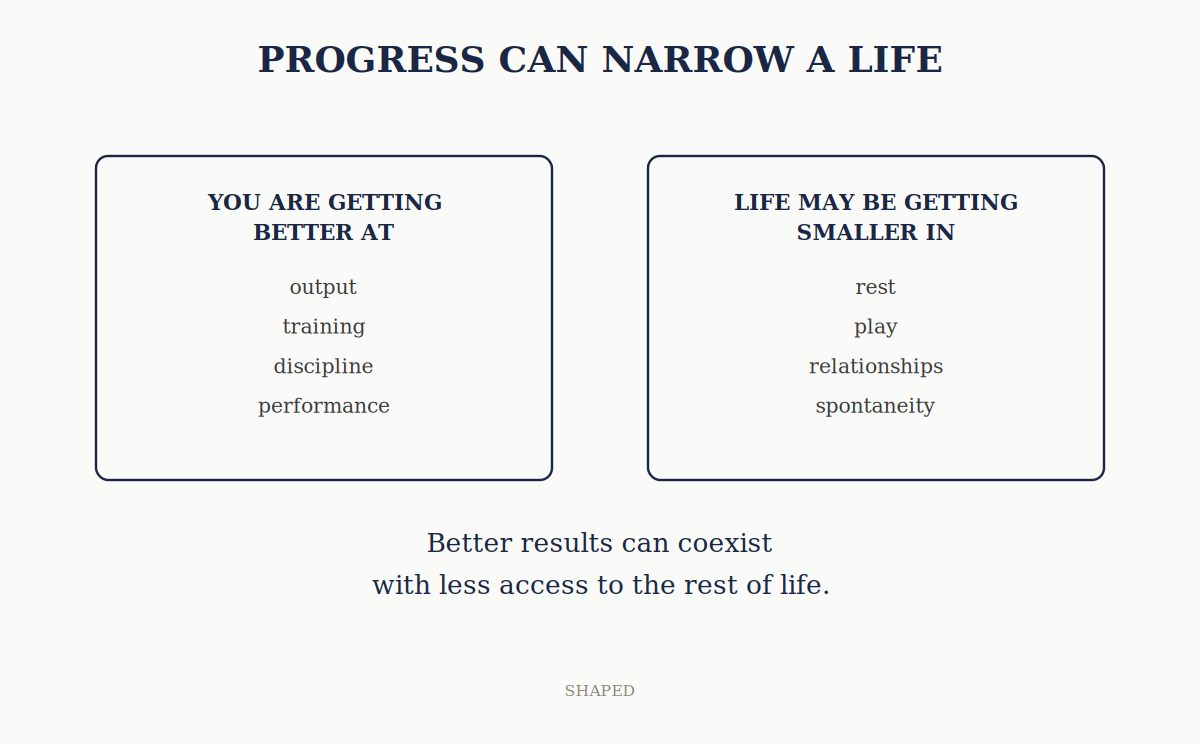
How improvement can strengthen one part of a life while other parts disappear from view
We are usually taught to recognise progress by addition: more skill, more responsibility, more discipline, more confidence, more success. If a person can do more, we tend to assume they are becoming more. Often, they are.
Practice can turn uncertainty into competence. Experience can steady us. Commitment can produce work, relationships and lives that would not otherwise have existed. Yet progress does not only add. Sometimes, while one part of a person becomes stronger, other parts become harder to reach.
A person can be improving while narrowing.
The person who became very good at being needed
Imagine someone who has become the person others call when something goes wrong. They remember the detail, anticipate the problem and remain calm while everyone else becomes anxious. Over time, more responsibility finds them; they become trusted, their judgement improves and their career advances. That is real development.
But the same repetition can shape what becomes easiest to access. If they are usually approached when a decision is required, decisiveness gets more practice than uncertainty. If other people depend on their composure, calm authority becomes easier to show than visible confusion. Days that reward speed and resolution can eventually make pausing without an answer feel uncomfortable.
At some point they may struggle to enter a room without taking responsibility for it. At home, a conversation becomes another problem to solve; a quiet weekend feels strangely empty, and being cared for can feel less natural than providing care. They have become more capable, while perhaps becoming available in a narrower range of ways.
What repetition strengthens
What we practise becomes easier to perform. The pianist gains control, the nurse notices changes that others miss, the parent learns to prepare a meal while answering a question and watching a child, and the athlete learns to continue when discomfort arrives. These capabilities matter.
Repetition can also shape what we notice, expect and reach for next. The person rewarded for being funny may reach for humour before sadness can be seen. A child praised for being easy may become skilled at needing very little in public. An athlete who learns to continue through discomfort can become less able to recognise when stopping would be wise, while a manager who survives pressure by controlling every detail may become better at control and worse at trust.
The improvement is real. So is the narrowing.
The improvement is real. So is the narrowing.
A person’s strongest capability cannot always tell us what else is available in them. It may tell us what their conditions have repeatedly required.
When strength becomes the only entrance
We build lives around qualities that work. Achievement brings recognition, so achievement becomes a reliable way to feel valuable. Kindness keeps relationships stable, so kindness can become easier to offer than disagreement. Preparation reduces anxiety, so preparation becomes the condition under which action feels safe.
There is nothing inherently wrong with that. A capability can expand a life. The problem begins when one successful route becomes the only route through which a person can feel secure, useful or known. Then visible progress can start hiding its own cost.
The business grows while every relationship outside it weakens. Grades improve while the student loses interest in learning. A project succeeds because one person absorbs every unsustainable demand. A result can be good without every condition that produced it being good.
The behaviour was real. The conclusion may not be.
Success may prove, ‘I can do excellent work.’ It does not have to prove, ‘Excellent work is only available when I disregard myself.’
Narrowing is not always failure
There are periods when narrowing is necessary. During a crisis, attention may need to contract around what matters most. A new parent may live inside a smaller world for a while. Someone recovering from illness may have little capacity beyond food, medication, rest and the next appointment. A demanding piece of work may require invitations to be declined and routines simplified. That can be intelligent.
The question is whether the narrowing remains useful, whether it is still chosen and whether other parts of the person can return when conditions change. A temporary adaptation can become a permanent identity if nobody looks again.
‘I need to focus on this now’ can quietly become ‘I am someone who has no time for anything else.’ ‘I cannot manage that today’ can become ‘I am not the kind of person who does that.’ The adaptation may have been necessary even if the verdict no longer is.
A temporary adaptation can become a permanent identity if nobody reopens the case.
‘I need to focus on this now’ becomes ‘I am someone who has no time for anything else.’
‘I cannot manage that today’ becomes ‘I am not the kind of person who does that.’
The adaptation may have been necessary. The verdict may no longer be.
Give the strength full credit
Think about something you have genuinely improved: perhaps you are more confident at work, more consistent with exercise, better at managing money, calmer in conflict or more reliable for the people you love. Start by asking what that improvement has made easier and give the answer full credit.
Then notice what has become harder to reach alongside it. You may have become more independent while finding it harder to ask for help, better at keeping the peace while finding it harder to disagree, disciplined with food while less able to enjoy a meal you did not plan, or highly informed while less willing to enter a conversation before your view is complete. These are not accusations; they are additional evidence.
Choose one small condition to test. Let someone else carry one task. Enter one conversation without solving it. Take one recovery session without treating it as lost discipline. Leave one hour unmeasured. The aim is not to abandon what works, but to discover whether the capability can remain while more of the person becomes available around it.
Progress deserves recognition, including whatever that progress has left unexplored.
More may be available than your current conditions reveal