The tool can make the work faster, easier and sometimes better. The harder question is what happens to the person doing it.
Maria Imran, 20, from Slough, made a presentation about her own future.
She had university offers. Instead, she wanted a four-year Level 3 Engineering Technician apprenticeship at Mars Wrigley. Her parents were sceptical. Maria later said her mother thought she might be taking the “easy route and being lazy”.
So Maria tried to persuade them.
There is something very human about that. Not a government paper on the future of work. Not a prediction about artificial intelligence. A young woman trying to convince the people who loved her that the path she wanted to take was not a mistake.
Now in her second year, Maria says her parents are fully supportive and like to brag about her when guests visit. It is tempting to make this a story about Maria being right.
I don’t think we should.
Her parents wanted a good future for their daughter. Maria wanted one too. They were making different judgements from incomplete evidence. And none of them could know. Maria could not take both routes, reach 24, place the two versions of herself beside each other and decide which one developed better. You only get to live one of the alternatives.
That is what uncertainty means here.
A degree can change while you are taking it. A job can change while you are learning it. A task that once took an afternoon can disappear into software. Skills that seemed scarce can become widely available. So perhaps the useful question is not which route will win.
What do we actually need a route to do for us?
When the work disappears before the job does
Matthew Beane spent years studying people learning surgery.
In traditional surgery, becoming a surgeon involved gradually getting closer to the work. You watched. You helped. You took on more. Your hands increasingly entered the operation.
Robotic surgery changed that relationship.
The technology allowed the experienced surgeon to do far more from a console. Beane found that established ways trainees had learned through increasing participation became much less effective because their role in the actual work had shrunk.
Nothing had failed. The patient could still be operated on. The expert could do the work. The technology worked.
That was the problem.
The uncomfortable part is that nothing visibly needs to go wrong for a developmental opportunity to disappear. This does not mean preserving old surgical methods because they were difficult. It means understanding what the old participation was doing.
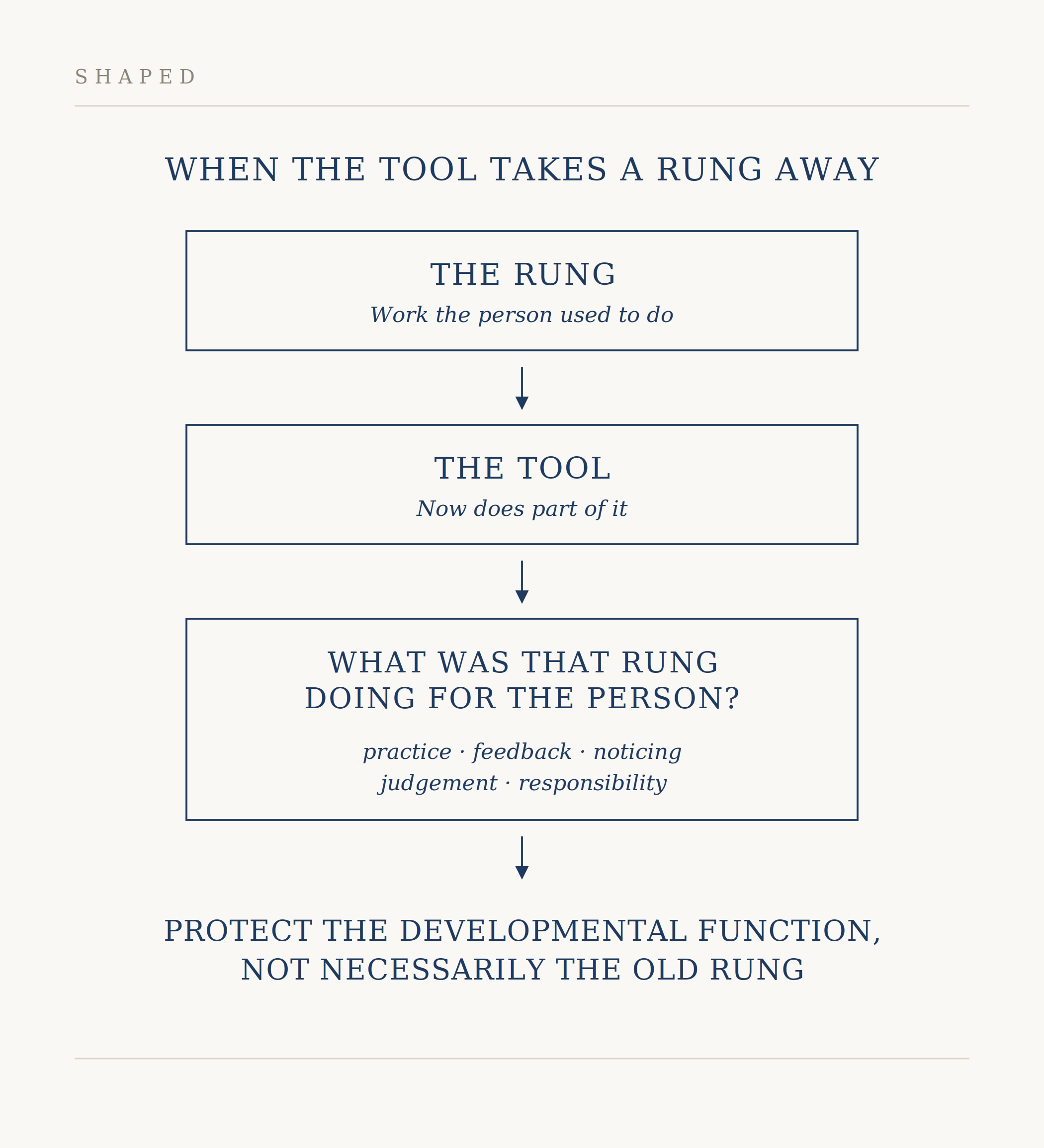
If a rung of the ladder contained observation, practice, error, feedback and increasing responsibility, removing the rung and replacing what it was doing are not the same thing.
Protect the developmental function, not necessarily the old rung.
Better work. Less development.
Researchers recently gave nearly a thousand school students different forms of GPT-4 assistance while they practised mathematics. With ordinary GPT assistance, their performance during practice improved substantially.
Then the tool was removed.
On the later exam, those students performed 17 per cent worse than students who had never received the AI assistance. Another group used a deliberately constrained version designed around teacher-created hints and support. The later harm largely disappeared.
Same underlying technology. Different conditions around its use. Different development. The unsettling part is not that the students performed badly while using AI.
They performed better.
They were receiving evidence that things were going well. That should matter to anyone using tools that can make the first draft cleaner, the code function, the analysis arrive faster or the presentation look stronger.
How would I know if I were producing better work and learning less?
The opposite can happen too.
Researchers followed more than 5,000 customer-support workers as an AI assistant was introduced. Less-experienced workers benefited particularly strongly. The most experienced agents saw much smaller gains, alongside a small decline in quality. The study suggests AI was helping newer workers acquire behaviours associated with more experienced agents rather than merely producing outputs for them.
Something was being left behind in the people.
That matters.
Time served is not development. Difficulty is not development. A tool that gives someone better examples, timely feedback, useful distinctions or expertise they otherwise could not reach may shorten an experience curve in a very good way.
The question is not simply whether the tool was present.
It is what the person still had to do while using it.
You do not graduate from this problem
It would be convenient if this were only a problem for beginners. It isn’t.
In 2025, researchers studying experienced endoscopists found that their performance detecting abnormalities without AI assistance declined after three months of routinely using an AI detection system. It was an observational study, so it cannot establish that AI caused the decline. The finding matters because these were experienced clinicians who already possessed the skill.
Aviation offers another clue.
When researchers put airline pilots into a Boeing 747-400 simulator, basic instrument scanning and manual aircraft control remained relatively robust despite extensive automation. The more vulnerable abilities were some of the thinking parts: tracking where the aircraft was without a map display, working out what came next, and recognising that an instrument system had failed. Pilots who remained more mentally engaged while automation operated appeared to retain those cognitive abilities better.
A tool may not weaken every part of a skill equally.
Which part stopped being exercised?
Joe Gilroy understood that problem from inside the cockpit. He retired from Delta in March this year after 45 years of flying and around 26,000 incident-free flight hours. On a typical ten-hour A330 flight, onboard data showed that pilots had the autopilot disengaged for only about six minutes.
Gilroy deliberately did more. He hand-flew departures to around 18,000 feet and took the autopilot off again at about 10,000 feet on arrival. Even then, his own average was only around 18 minutes in ten hours. He wanted to stay sharp. Gilroy did not hand-fly because the autopilot was bad.
He hand-flew because it was good.
The aircraft could perform so much of the task that he no longer needed to practise parts of it very often. He sometimes chose to anyway. Early in his training, Gilroy remembers being told that airline pilots of the future would increasingly become systems monitors whose real job would be high-quality decision-making. He thought the prediction was wrong. By the end of his career, he believed it had been right.
His own version was simpler: “I get paid to make good decisions. I fly the airplane for free.”
Today he runs a flight school and mentors people trying to become professional pilots. His story holds the whole problem: formation, maintenance and succession. A task can produce something and, less visibly, develop the person producing it.
When technology removes part of that task, we see the production gain immediately. What disappears from the person’s development may take much longer to reveal itself. Which parts of what I no longer need to do am I perfectly happy to lose – and which were quietly keeping me capable?
I have found SFIA – the Skills Framework for the Information Age – very useful in my own work because it gives me a practical way to separate the skills and responsibility a role requires from the capability of the person doing it. I think that distinction will become increasingly useful for others too as technology changes the work faster than many job descriptions do.
Capability and the evidence of capability can also move at different speeds.
This is another expression of what I call Crump’s Law.
As people change through time, technology can make evidence of earlier versions of them increasingly available to current judgement.
Maria’s family gives us the ordinary version. Her mother’s first judgement changed when new evidence became available. Here, capability, output and other people’s judgement can all update on different clocks.
Technology can create the reverse tension too.
The output can become more capable-looking faster than the person underneath it develops. A polished answer can arrive before the person knows enough to recognise why it is wrong. And the tool can give you an answer to the question you asked.
That does not mean you asked the right question.
What will you still be able to do?
Maria is still only halfway through her apprenticeship. She cannot know exactly what engineering will ask of her in ten years. Neither can you know exactly what your work will ask of you. That makes the choices being made now more important, not less.
Every time a tool takes over part of something you used to do, there is an opportunity to ask a harder question than whether it saved you time. What am I no longer having to learn, notice, practice or decide? Some answers will be welcome.
There are things we should gladly stop doing. There are old tasks that deserve to disappear. Technology can remove friction, widen access to expertise and help people develop faster. Then there are the capabilities you may still need when the easy case ends.
When the answer looks convincing and is wrong. When the familiar process no longer fits. When the situation is new. When someone turns to you because the decision cannot simply be handed back to the tool.
That is where today’s choices become tomorrow’s capability.
Joe Gilroy understood this. Automation could fly more of the aircraft, so he deliberately kept doing some of the flying himself. He was protecting something he still wanted available when it mattered.
The same decision is appearing in more ordinary places.
Did I ask the right question before I asked the tool?
What did I still work through myself?
What do I still practise for when the conditions change?
There is no virtue in making work unnecessarily difficult. There is a risk in making it so easy that we stop noticing what the difficulty used to develop. The technology will keep improving.
That is exactly why this question cannot wait for the technology to settle.
What will you need to be able to do when the conditions change – and is the way you work and learn today preparing you for it?
Sources
Maria Imran – BBC South report syndicated by AOL (live link checked 1 September 2026)
Matthew Beane – Shadow Learning: Building Robotic Surgical Skill When Approved Means Fail
Hamsa Bastani et al. – Generative AI without guardrails can harm learning
Erik Brynjolfsson, Danielle Li & Lindsey Raymond – Generative AI at Work
Stephen Casner et al. – The Retention of Manual Flying Skills in the Automated Cockpit
Joe Gilroy – The Aviation Business Podcast (Right Rudder Marketing), 6 May 2026
SFIA Foundation – SFIA skills profiling: profiles describe roles, not people
Companion Field Note: What Has AI Stopped You Practicing?