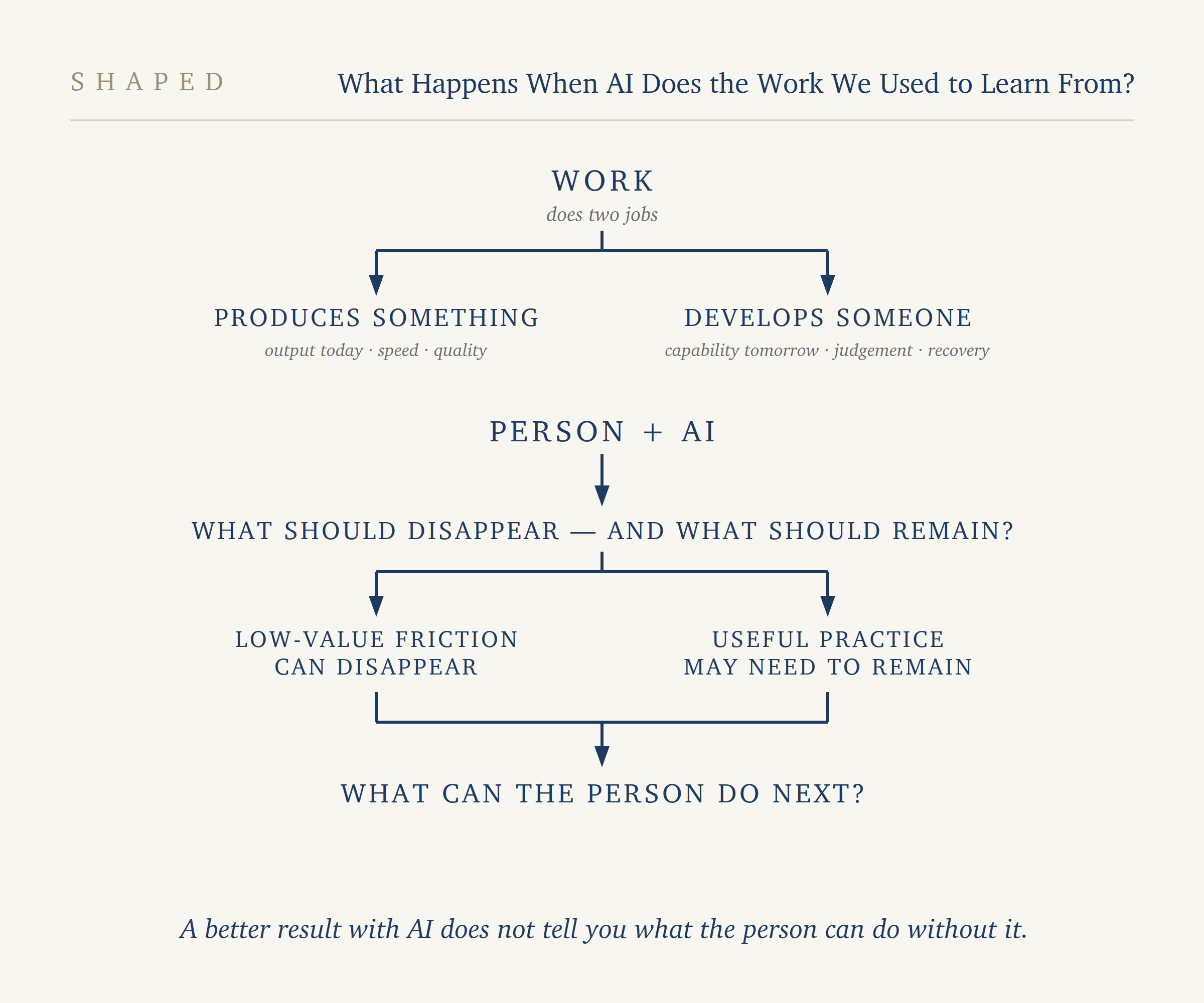
AI can make work faster, easier and sometimes better. But some of the work it removes was also where people learned how to think, notice, recover and judge.
A surgical trainee can be in the operating theatre while an operation goes well and still lose something important.
Matthew Beane spent two years studying how surgeons learned across five sites, comparing traditional and robotic practice. In traditional surgery, trainees learned by gradually doing more of the operation under supervision. Robotic surgery changed that. It greatly reduced the trainee’s role in the work, and the usual route from watching to doing to competence stopped working for many. Only a minority found alternative “shadow learning” routes that got them there.
The point is not that robotic surgery is bad. It is that a technology can improve or transform the work while changing the conditions in which the next person learns to do it.
The hidden job inside work
Work often does two jobs at once. It produces the thing we are paid for, and it develops or refreshes the capability of the person doing it. Teachers of every trade have known some version of this as learning by doing.
In 1983, Lisanne Bainbridge described one of the “ironies of automation”. As systems take over more routine work, the human can be left responsible for the unusual moments precisely when their ordinary practice has been reduced. A later meta-analysis found the same trade-off across experiments: more automation improved routine performance, but higher levels of automation could reduce situation awareness and performance when the automation failed.
Generative AI brings that old problem into a much wider class of work. It can write the first draft, analyse the document, produce the code, compare the options, suggest the diagnosis and prepare the recommendation. Those are outputs, but they can also be the activities through which people learn what good looks like, notice where mistakes hide and build the judgement required when the obvious answer stops working.
Some of the work AI removes was also where people learned how to do the work.
That does not mean we should preserve every awkward process in the name of development. Most of us have done work that taught us nothing except how much we wanted it automated. The useful test is whether the capability being practised is still needed for understanding, checking, adapting, recovering when something goes wrong, or reaching the next level of expertise. If it is genuinely obsolete, letting it fade may be progress.
The trouble begins when we remove the practice but continue expecting the judgement.
Better work does not always mean more learning
We are beginning to see this with generative AI itself. In controlled studies, people using AI have sometimes produced better work while developing less independent mastery.
In one 2026 coding trial, mostly junior software engineers learned a new Python library. The AI-assisted group completed the task a little faster, but the difference was not statistically significant; on a later mastery test, they scored 50 per cent compared with 67 per cent for those who coded by hand. How they used the AI mattered: people who asked conceptual questions and used it to build understanding tended to retain more than those who delegated the work.
Another controlled experiment with 130 novices found that the highest-offloading AI produced the best immediate accuracy and the fastest decisions, but less improvement in independent skill than the no-AI group. And in a study of nearly 1,000 high-school maths students, unrestricted GPT support improved performance while it was available, but students performed worse when it was removed. A more carefully designed tutor largely protected against that loss.
A better result with AI does not tell you what the person can do without it.
When experience changes the result
A new three-month field experiment, funded by Google, makes the question harder rather than simpler. The researchers followed 133 practising patent lawyers across 11 US intellectual-property firms. Lawyers given an AI drafting tool produced higher-quality work, with larger assisted gains among junior lawyers.
Then the AI was removed. The authors report that, on an unaided redlining task requiring professional judgement, the AI group still outperformed the control group overall, but the average retained improvement was concentrated among senior lawyers. Juniors showed no average retained gain, and their results became more spread out: some did well, some poorly.
That is not evidence that junior lawyers became worse. The trial was pre-registered, but it remains a September 2026 NBER working paper rather than a peer-reviewed publication. Google paid the direct costs and several authors disclosed Google employment, contracting or other support. The follow-up tested redlining rather than the original drafting task, and three months is a short window for judging professional development.
It still leaves a serious question. If experienced people can sometimes extract more lasting value from AI because they already know enough to challenge it, recognise its errors and understand what matters, where will the next generation get the foundational expertise that lets them use AI that way?
We do not know yet.
Nor is this only about people at the start of a career. A 2025 observational study across four Polish endoscopy centres examined 19 experienced endoscopists after routine exposure to AI-assisted polyp detection. When they later performed standard colonoscopies without AI, their adenoma detection rate was 22.4 per cent, down from 28.4 per cent before the AI was introduced. The study cannot establish that AI caused the fall, but it is a rare real-world signal that established expertise is not untouched when what people repeatedly practise changes. In a separate mammography experiment, incorrect AI advice reduced performance at every experience level, although the most experienced radiologists were less susceptible than novices.
Experience may offer resilience without immunity.
The same AI can do the opposite
This is why “AI makes us less skilled” is the wrong conclusion. Design matters.
A carefully designed AI tutor in a Harvard physics course helped students learn more in less time than an active-learning class. In a 2026 radiology trial, an AI scaffold combined image annotation with structured diagnostic prompts and feedback; students showed stronger retention and clinical decision-making over later assessments. The effects were unusually large and need replication, so the study is evidence of possibility, not a sensible prediction of what every AI learning tool will achieve.
The wider point is simpler. AI can remove useless work without removing learning. It can give someone feedback when an expert is unavailable, widen access to expertise, ask for a first attempt before helping, point to an error without fixing it, or make a person explain why they think an answer is right.
The same technology can substitute for thought or create better conditions for thought.
Which work should AI remove?
What must remain ours?
This matters because organisations increasingly talk about keeping a human “in the loop”. Presence is not the same as meaningful oversight. Recent work on medical AI argues that oversight requires people to have enough knowledge to understand what they are seeing, enough mental space to assess it, enough authority to challenge it, and a real ability to intervene when necessary.
That becomes difficult if the work that built those capacities has quietly disappeared. A system can weaken the very judgement capacity needed to revise the system. “Can” matters. The evidence does not show a general decline in intelligence, a profession-wide collapse in expertise or that tomorrow’s professionals will inevitably be worse than today’s. It shows something narrower: under some conditions, automation and AI can reduce the practice, independent mastery, error detection and critical engagement that later oversight depends on.
That takes us back to the surgical trainee, the junior lawyer producing better work with AI, and the experienced clinician whose unaided performance may also change when practice changes. We should automate work that no longer deserves human time while protecting the practice on which later judgement still depends.
If AI can do more of the work we used to learn from, what work do we still need to do ourselves?
Sources
• Lisanne Bainbridge, “Ironies of Automation,” Automatica 19(6), 1983.