Field Note: The useful question is not whether you used the tool. It is what you were still practising while you used it.
You finish something faster than you used to.
A first draft appears in seconds. The spreadsheet formula works. The code runs. The presentation has a structure. The document is cleaner than the version you might have produced alone.
That is real progress.
But there is another result that is harder to see.
What did you still have to do?
Tuesday’s article looked at the work that can disappear when a tool takes over part of a task. The point was not to preserve difficult work simply because it used to be difficult.
Some friction deserves to disappear.
Some tasks are better handed over.
And sometimes a tool helps us develop faster by giving us examples, feedback or expertise that used to be difficult to reach.
The question is what happens underneath the finished result.
Try this on one piece of work
Choose something you now do with a tool that you previously did mostly yourself.
It could be writing, coding, analysing information, researching, designing, planning, studying or preparing a presentation.
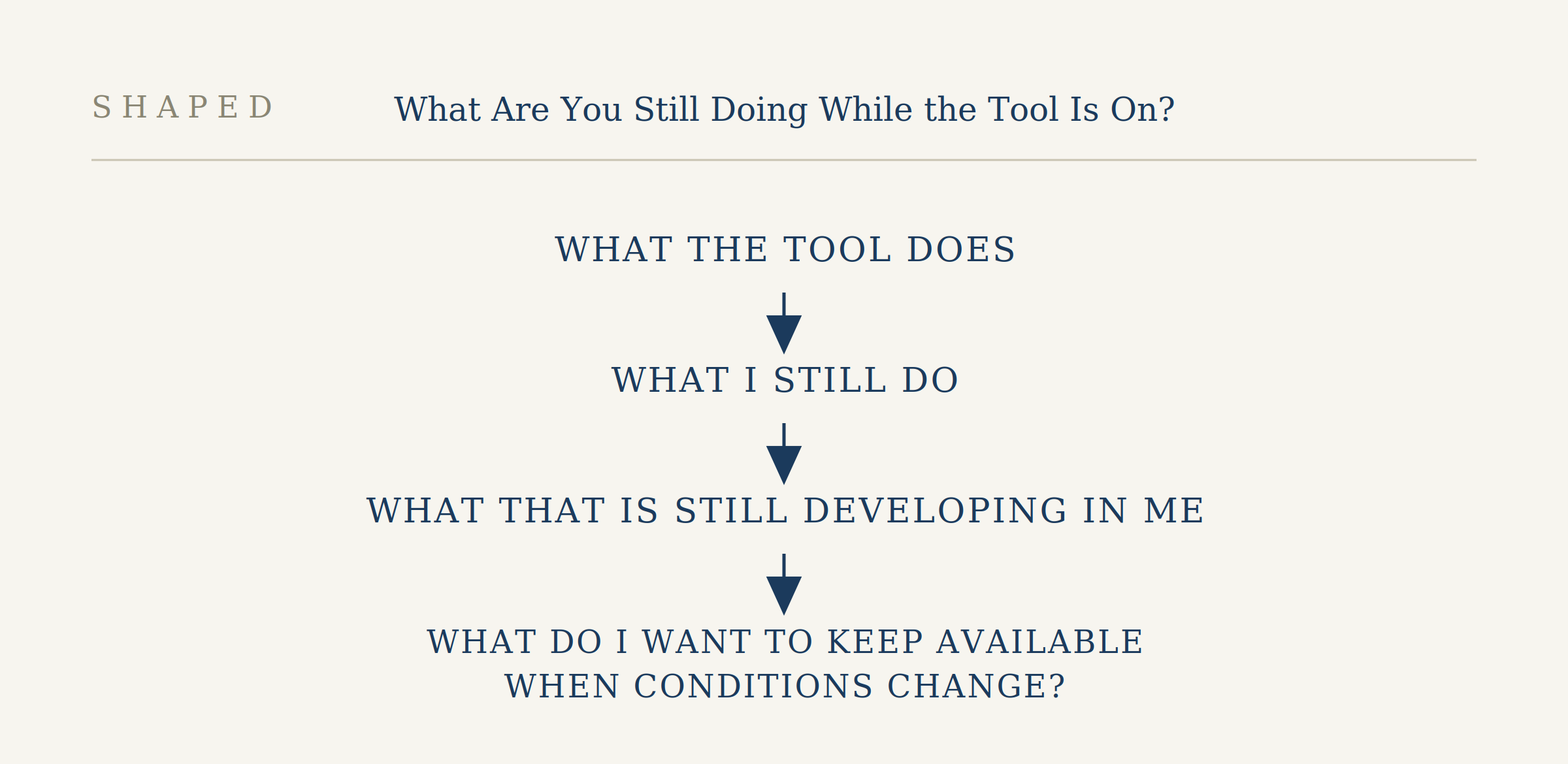
Then ask four questions:
- What is the tool doing now? Be specific. Drafting? Retrieving? Calculating? Structuring? Checking? Summarising? Suggesting what to do next?
- What am I still doing? Are you setting the question? Deciding what matters? Checking the evidence? Comparing alternatives? Spotting what does not fit? Making the final judgement?
- What is this still developing in me? Look underneath the task. Are you still practising, receiving feedback, noticing differences, building judgement or carrying responsibility?
- What do I still need to be able to do when the conditions change? What happens when the answer is wrong, the situation is unfamiliar, the problem falls outside the pattern the tool knows, or the tool is unavailable?
The aim is not to maximise the amount you do yourself. It is to know what you are choosing to stop practising.
The aim is not to maximise the amount you do yourself. It is to know what you are choosing to stop practising.
Imagine you use AI to help prepare an important piece of analysis.
Perhaps it finds material much faster than you could. Good.
Perhaps it organises the first draft better than you would have. Good.
But what are you doing while it does that?
Are you deciding which question matters? Are you recognising weak evidence? Are you noticing when two apparently similar cases are actually different? Are you able to explain why the conclusion follows — or are you accepting it because it reads convincingly?
If those things are still happening, the tool may be removing work while leaving important development intact.
It may even be improving it.
If they are no longer happening, that does not automatically mean you should turn the tool off. It means you have identified something worth protecting or rebuilding elsewhere.
Keep one thing active
On your next task, choose one capability you still want available when the conditions change.
Then make sure the way you use the tool still gives you some practice in it.
You might form your own view before asking for another one. Check one important source yourself. Explain why you accepted or rejected an answer. Work through the unfamiliar part before handing over the routine part.
Not because unaided work is purer.
Because the output and the person producing it are not the same thing.
A tool can make the work easier.
The more useful question is whether the way you are using it is still helping you become capable of what comes next.
If you want a more structured way to think about capability, I have found SFIA (Skills Framework for the Information Age) useful. It separates professional skills from responsibility levels and includes decision-making and judgement in its broader capability model.
Sources & further reading
• SFIA Foundation — SFIA framework and decision-making.
Companion to Week 10: “What If AI Makes Your Work Better — And Your Skills Worse?”