AI is making old evidence easier to find, combine and use. The harder question is what that evidence still deserves to mean.
Somewhere, there is probably an old version of you in a file.
It might be an appraisal written when you were struggling in a job, a school report, a medical note, a photograph, a complaint, an exam result, a qualification you earned years ago, or something you posted online and barely remember.
The harder problem is that it may still be true.
The appraisal may have been fair. The photograph may be real. The result may be accurate. You may genuinely have been the person that record describes.
People keep moving after the evidence is created.
Perhaps there is also an old version of somebody else in a file you created: an employee you once thought was unreliable, a colleague you did not trust with something important, someone you decided was not ready.
You may have been right too.
It can take years to change and seconds to retrieve who you were.
That matters because we spend a great deal of time encouraging people to develop. We ask them to learn, recover, mature, become more skilled, more confident, more dependable, better able to handle something that once overwhelmed them.
Yet the evidence produced before that development does not necessarily disappear when the person changes. Increasingly, it becomes easier to find.
The evidence does not have to be wrong
Mario Costeja González discovered an early version of this problem.
Old newspaper notices concerning him remained lawfully published in Spain. Years later, searching his name through Google made those notices prominently available again. The argument eventually reached the Court of Justice of the European Union.
In its judgment of 13 May 2014, the court held that links in search results could, in some circumstances, need to be removed when information had become inadequate, irrelevant or no longer relevant in light of the time that had passed. The original material could remain at its source.
For my purposes, the interesting point is not the law of delisting. It is that nothing had to become false. The information could remain historically true while the relationship between that information and a judgement about Costeja years later had changed.
We normally ask a simple question of evidence: Is it true? That question is not always enough.
A performance review can be an accurate account of how somebody worked in 2020 without settling how they work in 2026. An old qualification can be genuine without proving that the capability behind it has been maintained. A diagnosis can accurately describe what clinicians observed at one stage without describing everything that is available in the person now.
An old failure can make someone look worse than they have become. An old success can make someone look better than they are now.
The question is not only whether the evidence is true. It is what that truth is still evidence of.
When the past becomes easier to question
None of this began with AI.
In Delete in 2009, Viktor Mayer-Schönberger was already examining what cheap storage and easy retrieval might mean for forgetting, second chances and our ability to move beyond an earlier version of ourselves.
What is changing again is the mechanics.
Search made the past easier to find. AI can make the past easier to interrogate.
Searching normally requires some idea of what you are looking for. You remember the event, the document, the phrase, or at least the possibility that something exists.
AI can increasingly work the other way around. Give a system enough material and the question might become: When has this person struggled with leadership before? What patterns appear across their performance history? What evidence suggests this person is dependable? Where have their views changed? What contradictions appear across the record?
The person making the judgement may never have known the individual pieces existed.
Researchers working on long-term AI memory are already encountering technical versions of this problem. Systems can retrieve earlier information while struggling to recognise when it is stale, superseded or missing the context needed to interpret it correctly.
The human problem is harder still. A memory about a person does not always become stale because it has become false. It may become stale because the person moved.
Human development is not a promise that everybody improves. People gain things and lose them. They become more capable in one setting and less capable in another. Some early patterns persist; others do not. Research across the lifespan and across long-term life trajectories has repeatedly shown that later experience matters and that an early record does not fix the whole course of a life.
So we have two things moving at once: our ability to recover evidence is changing, and the person represented by that evidence may be changing too.
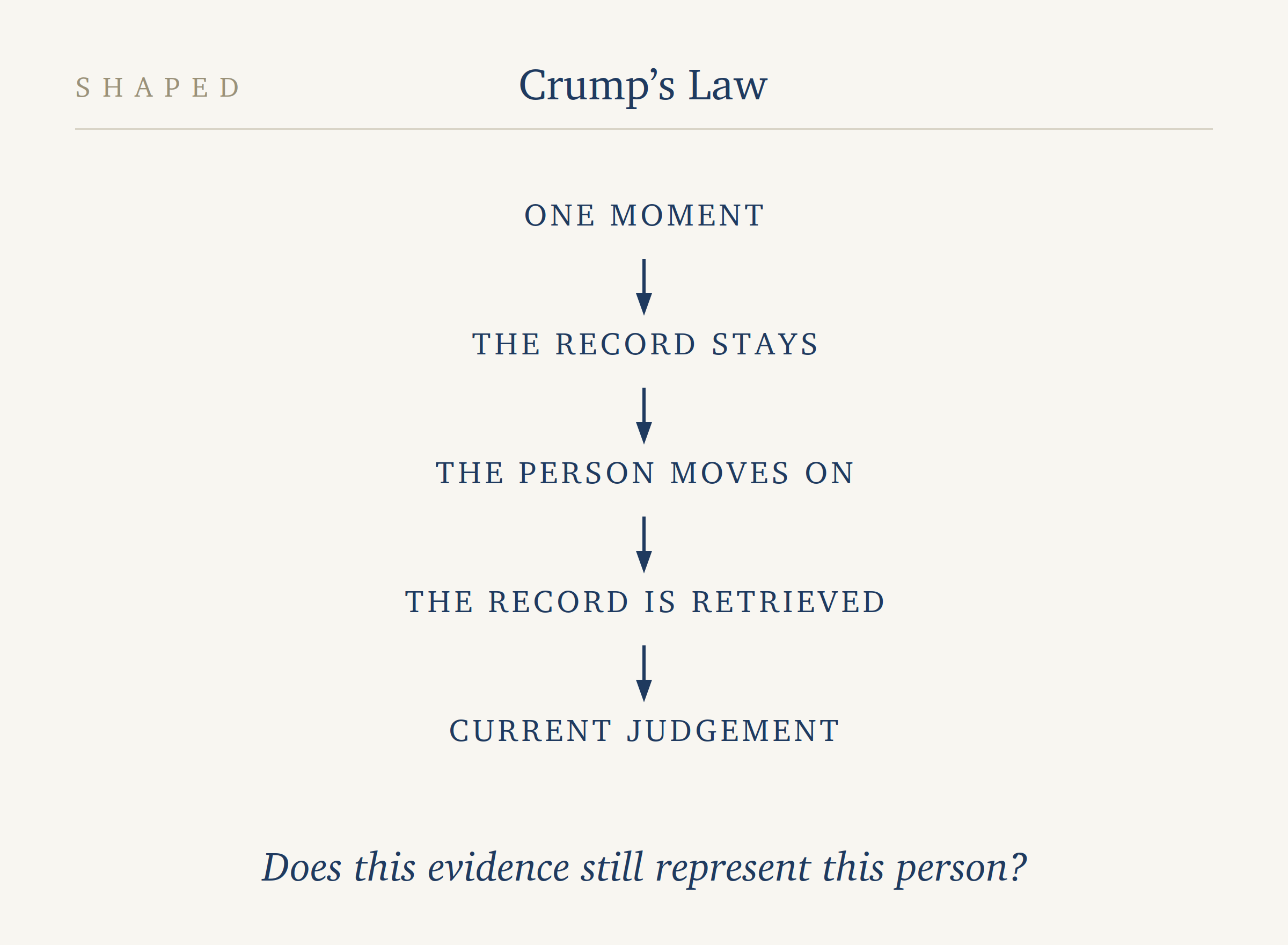
This is the problem I have come to call Crump’s Law:
As people change through time, technology can make evidence of earlier versions of them increasingly available to the judgement being made now.
There is a more compressed way of putting it:
Retrievability can increase while representativeness decreases.
That language is technical, but the idea is simple. Something can become easier to find at the same time as it becomes a poorer guide to the person now.
The word can matters. Old evidence does not automatically become less useful. A pattern visible across years may tell us more than the latest snapshot ever could.
Crump’s Law does not tell us what verdict to reach. It tells us there is a judgement to make.
ONE MOMENT → THE RECORD STAYS → THE PERSON MOVES ON → THE RECORD IS RETRIEVED → CURRENT JUDGEMENT
Does this evidence still represent this person?
Sometimes we desperately need the past
There is an obvious temptation at this point: give old evidence less power, let people escape what they once did, make room for development.
Andrew Malkinson shows why that answer is inadequate.
Malkinson was convicted of rape in 2004. Retained forensic material was re-examined as testing improved and a comparison became possible. His convictions were quashed by the Court of Appeal in 2023 after DNA evidence implicated another man. In April 2026, Paul Quinn was convicted of the 2003 rape and other offences and was later given an extended sentence of 24 years.
The evidence surviving mattered.
Sometimes the humane thing is to let old evidence lose weight. Sometimes the humane thing is to make sure it survives.
This is not an argument for forgetting, nor is it an argument that development should erase responsibility.
Preserving evidence and preserving its authority are different things. A record can remain extremely important as evidence of what happened. It might be crucial for accountability, safeguarding, history, medical care or the correction of an injustice. The same record may deserve a different weight when the question changes from What happened then? to Who is this person now?
And this is where the problem stops being theoretical.
You are on the panel
Imagine you are interviewing for a senior management role. The candidate is internal.
Six years ago, they were promoted into a substantial management position. It went badly. They struggled under pressure, difficult conversations were avoided and their team lost confidence in them. Eventually they stepped back into a specialist role.
Assume the record is fair. Nobody has distorted what happened.
Since then, the evidence looks different. Their performance has been consistently strong. They have led difficult projects, mentored colleagues, completed further development and taken on responsibilities that suggest greater confidence and judgement.
They want to lead again.
You might never have known the old episode existed. An AI-assisted summary prepared from your organisation’s own records has surfaced it because it appears relevant to the role.
Six years of a working life have been compressed into a summary, and one difficult period is suddenly prominent again.
Now add one condition. The team they would inherit is already in difficulty. It needs stable leadership quickly. This is not a comfortable environment in which to discover that the problems from six years ago are still present.
What do you do?
You could appoint them. Six years is a long time in a developing human life, and the later evidence is substantial. If people can never be trusted with something they once struggled to do, some verdicts become almost impossible to revise.
There is a catch. Much of the newer evidence was produced under different conditions. They have not yet demonstrated that the development holds when they are responsible for a struggling team, while the old evidence came from almost exactly the conditions you are considering putting them back into.
Declining them is defensible too. Your responsibility is not only to the candidate. There is a team on the other side of this judgement, and they will bear some of the cost if you are wrong.
Yet declining has a consequence of its own. If this is the only opportunity of its kind available, the candidate may never get the chance to produce the very evidence you say is missing.
The judgement about who they were starts affecting what evidence of who they are now can ever become available.
There is no trick answer here.
The six-year-old evidence is not worthless because the person has developed. The six years of later development are not irrelevant because they happened under different conditions. The team should not be turned into an experiment merely so somebody can prove they have changed. The candidate should not automatically be permanently defined by the last time they were tested in comparable conditions.
You have to decide what each piece of evidence is evidence of, how much weight it deserves, and what else matters to the judgement you are making now.
We already do this imperfectly with memory, reputation, records and inherited accounts of other people. AI may make the evidence richer, faster to retrieve and harder to overlook. That does not remove the need for judgement.
It increases it.
The old appraisal may still be true. The photograph may still be real. The conviction may still matter. The qualification may still exist. The pattern may genuinely be a pattern.
The person may also have moved.
The old evidence may still matter. It should not be allowed to answer a question it can no longer answer by itself.
The past deserves its place in the case. It does not automatically deserve the final word.
Does this evidence still represent this person — for this judgement, under these conditions, now?
Part II — Where Crump’s Law sits
For readers who want the intellectual underpinning.
Crump’s Law is not a claim that nobody has previously written about persistent records, privacy, rehabilitation, forgetting or human development. They have.
The claim is narrower. It concerns what happens when a changing person meets persistent evidence, increasing technological retrievability and a judgement being made now.
This problem has a history
Warren and Brandeis were asking in the nineteenth century what new technologies of capture and publication should be allowed to expose. James C. Scott later showed how institutions make complicated people and places legible by reducing them to categories, records and simplified representations.
Daniel Solove examined the persistence and aggregation of digital information. danah boyd described networked information as persistent, searchable and capable of reaching audiences beyond the context in which it was created. Helen Nissenbaum’s work on contextual integrity asked whether information that is legitimate in one setting should flow unchanged into another.
Mayer-Schönberger examined what happens when digital technology disrupts forgetting and second chances. The UK’s Rehabilitation of Offenders Act 1974 had already recognised, in a different form, that the historical truth of a conviction and the consequences society permits that truth to carry indefinitely are not identical questions.
Costeja brought truth, time and retrievability together in a legal dispute. Baltes, Laub and Sampson approached the other side of the problem: the person represented by the record may continue to develop, change direction, gain capabilities, lose others and move through different conditions across a life.
Crump’s Law sits among those ideas rather than replacing them. Its particular question begins once the evidence has arrived.
Privacy asks who should have access. Contextual integrity asks whether information should flow here. Right-to-be-forgotten law asks whether something should remain so easy to retrieve.
Crump’s Law asks what the evidence still represents now.
The right to be forgotten changes what can be found. Crump’s Law changes what the finder owes to the judgement.
Much of the privacy and forgetting literature understandably focuses on harmful old information. Crump’s Law is symmetric: old evidence can misrepresent by understating or overstating the person now.
One piece of evidence can serve different judgements
A great deal of confusion disappears once we stop treating every judgement about the past as the same judgement.
Historical — What happened?
Responsibility — What was theirs, under those conditions?
Current person — What does that evidence tell us about them now?
Predictive — What does it justify us expecting next?
The same evidence can be strong for one of these judgements and considerably weaker for another.
If we want to establish what happened in 2016, a record made in 2016 may be extremely valuable. Its age does not make it weak.
Responsibility requires another distinction. Pressure, authority, constraint, opportunity and the alternatives genuinely available to someone can matter without making the behaviour unreal.
Conditions can explain without exonerating.
Current-person judgement is different again. A historical act and the responsibility attached to it can remain completely real while ten years of later behaviour and development change what that act tells us about the person now.
Prediction asks something further: what does the accumulated evidence justify us expecting next? Historical truth does not automatically settle future risk or capability.
That is why the management case is difficult. The old evidence is strong evidence of what happened, relevant to responsibility, potentially less representative of the candidate today, yet still potentially predictive because the new role recreates some of the earlier conditions.
Those are not contradictions. They are different judgements.
Inside SHAPED
The larger movement in SHAPED is:
CONDITIONS → AVAILABILITY → BEHAVIOUR → EVIDENCE → VERDICT → FUTURE CONDITIONS
Crump’s Law sits particularly around the movement from evidence to verdict across time.
Evidence of earlier behaviour survives. It becomes available again later. Yet the person may have changed, their conditions may have changed and the judgement now being made may not be the judgement for which that evidence was originally created.
The final step in the chain matters too. A verdict does not merely describe someone. It can become one of the conditions they meet next.
A prospective corollary follows from that:
A judgement can alter the conditions from which later evidence is produced.
The management case gives us the ordinary version. Give someone responsibility and they may produce new evidence of development. Decline them and that particular evidence may never exist. Neither fact means the appointment should automatically be made.
It means judgement does not stand outside the future it helps create.
More evidence, arriving with more power
Data specialists have long described changing data environments through a series of V’s: volume, velocity, variety, veracity and value.
The terminology sounds technical. The underlying change is easy to recognise.
Volume means more traces of a life can be retained. That can give us a richer history, but more evidence does not guarantee that more of the person has been seen. It also increases the need to compress.
Velocity means evidence can be retrieved, analysed and acted upon faster. That can get crucial information into a decision in time. It can also reduce the pause between finding something and allowing it to affect somebody.
Variety means different forms of evidence can increasingly meet: records, messages, assessments, images, observations and behavioural traces. That can widen the case. It can also assemble fragments created for different purposes, under different conditions, into something that looks more coherent than it really is.
Veracity asks whether the evidence is true. That is essential, but Crump’s Law exposes why it is not enough.
Value asks whether the evidence is useful. Yet useful for what?
Evidence can be valuable for reconstructing an historical event and much less valuable for judging current capability.
So even if data becomes more plentiful, faster, more varied, better verified and easier to use, another question remains: what does an accurate piece of old evidence still tell us about the person now?
Even perfect data quality does not answer that.
That is the representativeness problem.
There is another direction this could take. Technology may not only make organisations better at retrieving your past. Personal records, personal data stores and AI agents acting on our behalf could also give people better ways to carry, connect and make available evidence of their own development. If that happens, the question will not only be what a system can retrieve about you. It will also be who gets to assemble the evidence that reaches the judgement.
AI intensifies it because several operations can increasingly happen together. Systems can retrieve evidence, bring fragments together, compare them, identify patterns and compress the result into something another person can act upon.
The distance between evidence existing and evidence becoming consequential is shrinking.
That offers enormous opportunity. Separate fragments can reveal safeguarding risks, medical history can be connected across encounters, and retained evidence can correct a terrible injustice.
It also gives representations of people more power.
Compression, magnification and reopening the case
No person can absorb an entire life. We have always compressed one another.
A record compresses. An appraisal compresses. A diagnosis, qualification and reputation compress. An AI summary compresses too.
Compression is necessary. The danger begins when the portable account is mistaken for the whole person.
Technology can then magnify what has been compressed. Search can make one old event highly visible. Repetition can make one account dominant. Institutional authority can give a fragment weight. An AI summary can place evidence directly in front of somebody who never thought to look for it.
At other times, connecting fragments does exactly what good judgement requires. It reveals a pattern that no single observer could see.
Sometimes the danger is that one fragment becomes too powerful. Sometimes the danger is that the fragments never meet.
That is why the response cannot simply be to remember less or collect less.
Good judgement sometimes requires us to reopen enough of the case to see the conditions around a fragment, the trajectory since it was created, the evidence that supports or contradicts it and the particular judgement now being made.
That is decompression in its simplest sense. It is not acquittal and it does not erase history.
It means refusing to confuse the portable account with the whole case.
And then we are back where we started:
Does this evidence still represent this person?
Sources
Court of Justice of the European Union, Google Spain SL and Google Inc. v AEPD and Mario Costeja González, Case C-131/12, Grand Chamber judgment, 13 May 2014.
Viktor Mayer-Schönberger, Delete: The Virtue of Forgetting in the Digital Age, Princeton University Press, 2009.
Paul B. Baltes, “Theoretical Propositions of Life-Span Developmental Psychology: On the Dynamics Between Growth and Decline,” Developmental Psychology, 23(5), 611–626, 1987.
John H. Laub and Robert J. Sampson, Shared Beginnings, Divergent Lives: Delinquent Boys to Age 70, Harvard University Press, 2003.
Samuel D. Warren and Louis D. Brandeis, “The Right to Privacy,” Harvard Law Review, 4(5), 193–220, 1890.
James C. Scott, Seeing Like a State, Yale University Press, 1998.
Daniel J. Solove, The Digital Person, New York University Press, 2004; and The Future of Reputation, Yale University Press, 2007.
danah boyd, “Why Youth (Heart) Social Network Sites: The Role of Networked Publics in Teenage Social Life,” in David Buckingham (ed.), Youth, Identity, and Digital Media, MIT Press, 2008.
Helen Nissenbaum, Privacy in Context: Technology, Policy, and the Integrity of Social Life, Stanford University Press, 2010.
Rehabilitation of Offenders Act 1974.
Hanxiang Chao et al., STALE: Can LLM Agents Know When Their Memories Are No Longer Valid?, arXiv preprint 2605.06527, May 2026.
Wei Yang et al., RaMem: Contextual Reinstatement for Long-term Agentic Memory, arXiv preprint 2606.22844, June 2026.
R v Malkinson [2023] EWCA Crim 954, Court of Appeal; hearing 26 July 2023, judgment handed down 7 August 2023.
Greater Manchester Police, “Man convicted of 2003 rape of woman, 20 years after miscarriage of justice,” 17 April 2026.
Greater Manchester Police, “Paul Quinn jailed for 2003 rape of woman, two decades after miscarriage of justice,” 5 June 2026.
Chris Henley KC, independent review of the Criminal Cases Review Commission’s handling of the Andrew Malkinson case, July 2024.