How noise, pressure, criticism and change can reach people with very different force
At 3.40 in the afternoon, the same message arrives in two inboxes:
Plans have changed. This needs to be redone by Friday.
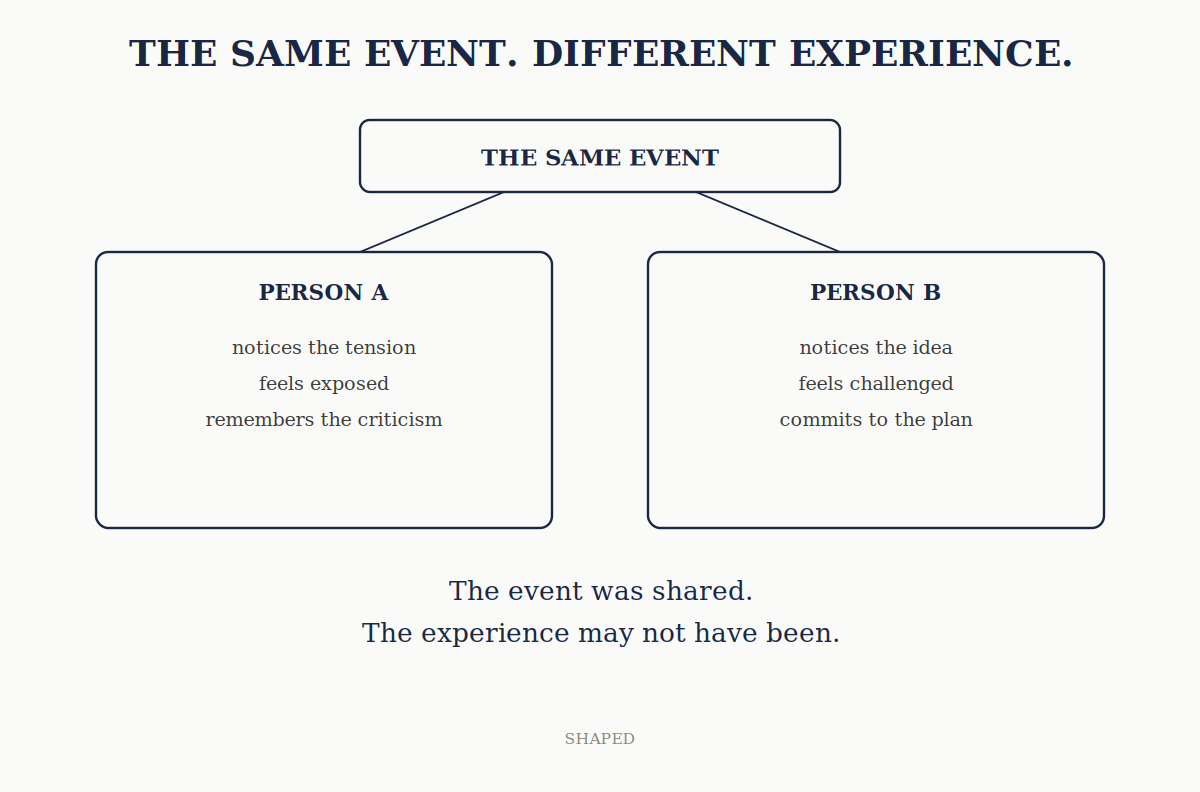
One person sighs, adjusts the diary and begins working through what must change. The other does the same, but also notices the abruptness of the message, the work that has just been discarded, the manager’s frustration and the difficult conversation that may now have to happen at home.
Both continue working, so from the outside there may be little difference. Inside, one person is carrying the additional task; the other is carrying the task and everything that arrived with it. Hours later, one has largely moved on while the other is still replaying the message.
We might explain the difference by saying one person is relaxed and the other takes things too personally, that one is resilient and the other sensitive, that one can cope and the other cannot. Perhaps. The same event may simply reach different people with very different force.
What passes through one person may stay with another
We already know that people differ in obvious ways. One person enjoys noise while another struggles to think with several conversations happening nearby. A last-minute change can feel energising to one person and force another to reorganise a plan they were already carrying in their head. Blunt feedback may arrive as useful information for one person while another registers the information, tone, timing, relationship and what the criticism might mean.
These differences are not always visible. The person who is more affected may still meet the deadline, stay at the gathering, complete the session or respond calmly. They may have become highly skilled at continuing while carrying more.
The behaviour may look similar even when the human demand is not. This is the second half of an idea we often miss: the same person can behave differently as circumstances change, and the same circumstances can affect different people differently.
Where the estimate comes from
People vary along a continuum in how strongly they register and process what is around them. Researchers sometimes use the term environmental sensitivity to describe this variation.
One influential 2018 study of about 900 psychology undergraduates found an approximate split of 30 per cent lower, 40 per cent middle and 30 per cent higher — around three in ten of that sample toward the higher end. It was not a population survey, so the result should not be read as a precise count of society.
Across the wider research, estimates vary by sample, measure and threshold. SHAPED therefore uses a cautious formulation: roughly 20 to 30 per cent of people may sit toward the higher-scoring end. That is a substantial minority, but not a separate type of person; all of us are affected by what surrounds us.
The difference may be how much we register, how deeply we process it, which parts reach us most strongly and how long the effects remain. Our response can also change with the day. Sleep, health, pressure, past experience, familiarity and the importance of what is happening may all alter the force with which something lands.
The useful point is not to divide humanity into sensitive and insensitive people, but to stop assuming that equal exposure creates equal load.
More affected does not mean weaker
Being more responsive to an environment is often discussed only when it creates difficulty: noise becomes overwhelming, criticism lingers, conflict is hard to set aside or too much change leaves someone depleted. Those effects can be real.
But greater responsiveness does not mean being affected only by difficult conditions. Research suggests that people who score higher on measures of environmental sensitivity can be more affected by both adverse and positive experiences. Much of the wider evidence shows patterns rather than causes, and findings vary across people and settings, so this is a possibility worth knowing rather than a promise.
Encouragement, safety, care, absorbing work and supportive surroundings may reach with greater force too. Someone who notices tension may also notice when another person has been left out; someone affected by a harsh atmosphere may respond strongly to genuine warmth; someone who struggles with relentless interruption may produce thoughtful work when given enough quiet and time.
Greater responsiveness does not guarantee greater accuracy. A person may correctly register tension, noise or rising overload and still misread its cause or meaning.
The signal may be real. The interpretation still needs context.
This is not a hidden-superpower story. Greater responsiveness can carry genuine costs, and better surroundings do not remove illness, grief, disability, danger or every difficult demand. What makes someone easier to overload may also make them more responsive to care, meaningful work and the right surroundings.
The environment is more than the place
When we hear the word environment, we may think of lighting, temperature, noise or the physical room. Those things matter.
But what surrounds a person also includes pace, uncertainty, expectation, status and other people.
A workplace can be physically quiet while remaining socially exhausting. A family gathering can be noisy but feel safe. A coach can set a demanding standard in a way that leaves the athlete feeling trusted rather than threatened. A change of plan can be minor in practical terms but arrive after a week in which someone has already adapted ten times.
The event we can see is only part of what reaches the person, yet we often judge the reaction without examining the load. We wonder why they are still thinking about it, need so much notice, cannot ignore the noise or were affected so strongly by a comment.
Sometimes the person does need to develop a skill, tolerate necessary discomfort, communicate more clearly or take responsibility for their response. At other times, we may be asking them to become better at carrying a demand that other people barely had to carry at all.
Equal treatment is not always equal experience
This becomes important when we create circumstances for other people.
A leader may believe they have treated everyone equally because the same message, deadline and meeting were given to the whole team. A teacher may give every student the same time, instructions and room. A parent may assume that two children experienced the same household.
But sameness in what was provided does not guarantee sameness in what was received. That does not make fairness simple. Nor does it mean every environment should be redesigned around the most affected person.
It means we should be careful about using one person’s response as the standard by which everyone else is judged.
‘It did not bother me’ is evidence about one person.
It is not proof that the demand was small.
Notice what reached you — and what did not
Think of one or two moments from the past few days involving noise, criticism, uncertainty, an abrupt change or someone else’s tension. Did any of them stay with you, pass quickly or barely register at all?
Before calling the reaction excessive, try to name the part that carried the force. Was it the workload itself or the effort of responding to several people with different priorities? The feedback or the fact that it was public? The change or having no time to rebuild the plan? The conversation or the uncertainty about what it meant?
Then notice what happened afterwards. Did the effect pass quickly or follow you home? Did quiet, movement, information, reassurance or one useful conversation help it settle?
If nothing seemed to reach you strongly, that is useful information too. It may tell you something about those moments, your state at the time, the surroundings or the support available. It does not mean you are always unaffected.
The aim is not to prove that you are unusually sensitive. It is to learn more accurately what reaches you, what it costs and what helps you recover enough to choose your next response. Later, the same question can be asked for another person — especially the one whose reaction you find hardest to understand.
The event was shared. The load may not have been.
Sources
Lionetti, F., Aron, A., Aron, E. N., Burns, G. L., Jagiellowicz, J. and Pluess, M. (2018). Dandelions, tulips and orchids: evidence for the existence of low-sensitive, medium-sensitive and high-sensitive individuals. Translational Psychiatry, 8, 24. https://doi.org/10.1038/s41398-017-0090-6
Pluess, M., Lionetti, F., Aron, E. N. and Aron, A. (2023). People differ in their sensitivity to the environment: An integrated theory, measurement and empirical evidence. Journal of Research in Personality, 104, Article 104377. https://doi.org/10.1016/j.jrp.2023.104377
Assary, E., Krebs, G. and Eley, T. C. (2023). Practitioner Review: Differential susceptibility theory: might it help in understanding and treating mental health problems in youth? Journal of Child Psychology and Psychiatry, 64(8), 1104–1114. https://doi.org/10.1111/jcpp.13801